
Siding Installation in Closter, NJ
Northern Valley Homes Deserve More Than a Quick Fix
Hear from Our Customers
Siding Contractors in Closter, NJ
When siding fails in Closter, it rarely announces itself. It shows up quietly — as a damp smell in a bedroom wall, a soft spot behind the trim, or a heating bill that keeps climbing. By the time it’s visible from the street, water has usually been working behind the surface for a while. The right installation stops that before it starts.
Closter’s housing stock tells the story clearly. Most of the borough was built out in the 1950s and 1960s, after the Palisades Interstate Parkway opened and families started moving into the Northern Valley in earnest. That means a large share of homes here are 60 to 70 years old — and the siding on many of them is either original or was replaced once, decades ago. First-generation vinyl from the 1980s and 1990s is now 30 to 40 years in. It was never meant to last this long.
The freeze-thaw cycles Bergen County puts homes through every winter are relentless. Water gets into micro-cracks, freezes, expands, and opens those cracks a little wider each season. When the siding is properly installed — with the right moisture barrier, correctly lapped panels, and flashing that actually seals at every penetration — that cycle stops doing damage. Your walls stay dry, your insulation stays effective, and your home holds its value in a market where buyers and their attorneys look closely at everything.
Local Siding Company in Bergen County
We’ve been working on homes in Bergen County for nearly ten years. Not a franchise. Not a seasonal crew. A local, family-run operation that built our reputation the hard way — one project at a time, through word-of-mouth from homeowners in Closter, Demarest, Cresskill, and surrounding communities who told their neighbors.
That matters in a community like Closter. This is a town where people talk. Where your neighbor at Closter Plaza knows our name, and where a bad job follows a company for years. The reviews that drive this business aren’t from a marketing campaign — they’re from real homeowners in the Northern Valley who saw the finished work and chose to share it.
Being a full-service exterior contractor — roofing, gutters, and siding — also means we understand how a home’s exterior works as a system. Where a siding-only crew might miss a flashing issue at the roof-wall line, or leave a gutter problem that feeds water directly behind new panels, we catch it. Because we’ve seen what happens when those details are skipped.

Residential Siding Contractors in Closter, NJ
It starts with a free inspection. A trained eye walks your exterior — not just the siding panels, but the substrate underneath, the flashing at every transition, the condition of trim and corner posts, and anywhere moisture may have already found a way in. For older homes in Closter, especially the mid-century colonials and split-levels that make up most of the borough, that assessment often reveals things a surface-level quote would miss entirely.
From there, you get a written estimate. Not a ballpark, not a verbal number that shifts when the crew shows up — a written scope of work with materials, labor, and pricing spelled out before anything starts. In New Jersey, siding replacement typically requires a construction permit through the borough’s Construction Code office. We handle that process for you, so you’re not chasing paperwork or worrying about what shows up in a permit history search when you eventually sell.
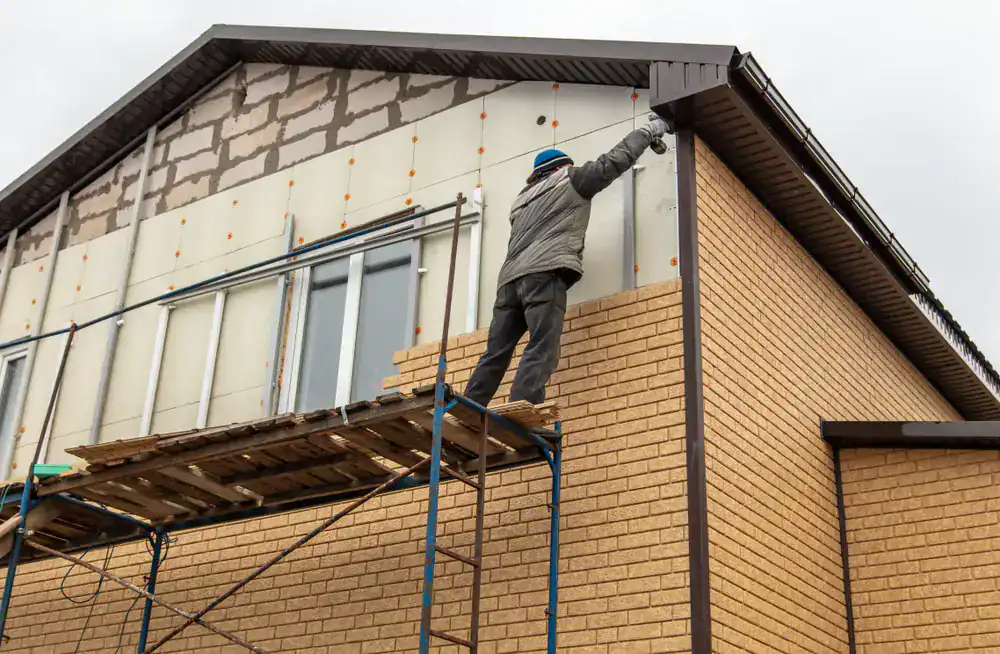
Installation is done with the Bergen County climate in mind. That means proper moisture barriers, correctly installed flashing at every window, door, and roof-wall intersection, and panel installation that accounts for seasonal expansion. When the job is done, the site is cleaned and you do a walkthrough. If something isn’t right, it gets addressed before the crew leaves — not after a series of calls and follow-ups.

Ready to get started?
Vinyl Siding Contractors in Closter, NJ
Not every home in Closter needs the same solution. The Colonial Revival on High Street has different needs than the split-level off Ruckman Road, and a contractor who leads with one product for every job isn’t giving you a recommendation — they’re giving you their preference. The conversation about materials should start with your home, your goals, and how long you plan to stay.
Vinyl siding remains the most common choice in Bergen County for good reason. Modern insulated vinyl performs significantly better than what was installed in the 1980s — better impact resistance, tighter tolerances, and improved thermal performance. For homeowners who want something that reads as more architectural, fiber cement like James Hardie holds paint longer, resists moisture more aggressively, and stands up well to the kind of wind-driven rain that comes through during a nor’easter tracking up the coast. Engineered wood options like LP SmartSide offer a natural look with better dimensional stability than real wood in New Jersey’s humidity swings.
What we tell you about each option is honest — including the trade-offs. Fiber cement costs more upfront and requires repainting over time. Premium vinyl is lower maintenance but has a different look. The goal is to match the right material to your home and your expectations, not to upsell you on the most expensive option. We are manufacturer-certified, which means the installation meets the specifications that keep your warranty valid — and that’s a detail worth confirming with any contractor you consider.

Do I need a permit for siding replacement in Closter, NJ?
Yes, in most cases you do. Closter operates under New Jersey’s Uniform Construction Code, and exterior work including full siding replacement typically requires a construction permit through the borough’s Construction Code office. This isn’t just a formality — it matters when you sell. Bergen County real estate transactions involve attorney review, and permit histories get pulled. Unpermitted exterior work can delay a closing, reduce your negotiating position, or come up as a defect disclosure issue.
A reputable contractor handles the permit process as part of the job. If someone quotes you a price and permit costs aren’t part of the conversation, ask why. We manage permitting on your behalf so the work is properly documented, inspected, and on record — which protects you both now and when you’re ready to sell a home worth what Closter homes are worth.
How much does siding installation cost for a typical home in Closter?
It depends on the size of the home, the material you choose, and what the inspection reveals about substrate condition. For a typical single-family home in Closter — most of which are four to five bedrooms on generous lots — a full siding replacement generally runs somewhere in the range of $15,000 to $35,000 or more, depending on material selection. Fiber cement and insulated vinyl sit at the higher end of that range. Standard vinyl comes in lower.
What affects the final number most is what’s behind the existing siding. In older homes — and most of Closter’s housing stock is 60 to 70 years old — there’s sometimes water damage to sheathing or framing that needs to be addressed before new siding goes on. That’s not a surprise we should spring on you mid-job. It’s exactly why a thorough inspection before the estimate matters, and why a written estimate that accounts for what was actually found is worth more than a fast number given over the phone.
What siding material holds up best in Bergen County's climate?
Bergen County winters are hard on exterior materials. The freeze-thaw cycling — water infiltrating small gaps, freezing, expanding, and widening those gaps over successive seasons — is the primary mechanical stress on siding in this region. Add in the wind-driven rain that comes with nor’easters, and the humid summers that create conditions for moisture accumulation behind failing cladding, and the material choice matters more than most homeowners realize.
For most Closter homes, insulated vinyl or fiber cement are the strongest performers in this climate. Insulated vinyl handles thermal movement well and gives you an added layer of energy performance. Fiber cement — particularly James Hardie products — resists moisture intrusion aggressively, holds up in freeze-thaw conditions, and is less susceptible to impact damage from storm debris. The right answer depends on your home’s architecture, your budget, and how long you plan to stay. That conversation is worth having before you commit to a material, not after the truck shows up.
How do I know if I need siding repair or full replacement?
The honest answer is that you often can’t tell from the outside alone. Siding can look passable from the street while hiding significant moisture damage behind it — especially in homes that were built in Closter’s post-Parkway development era, where original or early-replacement cladding has been on the structure for decades. Fading, cracking, and warping are visible signs. But the more important indicators are what you find when you probe the substrate: soft spots, discoloration, mold growth, or sheathing that’s lost its integrity.
A free inspection from us gives you that information without committing to anything. If the damage is isolated — a section around a window that wasn’t properly flashed, or a corner that took impact damage — targeted repair may be the right call. If the moisture barrier has failed across a significant portion of the wall, or the siding is 30 to 40 years old and showing widespread deterioration, full replacement usually makes more financial sense than patching a system that’s already compromised. We’ll tell you which one applies to your home, not which one generates a bigger job.
How long does a siding installation take on a Closter home?
For a typical single-family home in Closter, a full siding installation generally takes three to five days once the crew is on-site. Larger homes — and Closter has a significant share of four and five-bedroom properties on large lots — can run closer to a week depending on complexity. Homes with dormers, multiple rooflines, or detailed trim work take longer than simpler structures, and the inspection findings can affect the timeline if substrate repairs are needed before new siding goes on.
Timing within the year also plays a role. Spring and early fall are the strongest installation windows in Bergen County — temperatures are stable, the siding material behaves predictably, and you’re not working against the cold-weather limitations that come with vinyl in particular. Vinyl becomes more brittle in sub-freezing temperatures and requires additional care during winter installation. If you’re planning a project and want it done before the next winter cycle, spring is the time to schedule — not after the first freeze.
How do I find a licensed siding contractor in Closter, NJ I can actually trust?
Start with the legal baseline: every contractor performing home improvement work in New Jersey is required to register with the NJ Division of Consumer Affairs under the Home Improvement Contractor program. Ask any contractor you’re considering for their HIC registration number and verify it. In Closter, where homes are worth $1.3 million or more, hiring an unregistered contractor isn’t just a risk to the quality of the work — it’s a legal and financial exposure with no recourse under the Consumer Fraud Act if something goes wrong.
Beyond licensing, look at how long the company has been operating in Bergen County specifically. Local contractors who have worked in the Northern Valley for years understand the housing stock, the permit process, the climate, and what actually goes wrong with siding on homes like yours. Check their reviews — not the testimonials on their own website, but their Google Business Profile, where the feedback is unfiltered. A company that has grown through referrals from real homeowners in communities like Closter, Demarest, and Cresskill has earned that reputation in the same market where you’re making your decision. That’s a different thing than a company with a polished website and no local track record.