
Roofer in Englewood, NJ
Englewood Homes Deserve More Than a Quick Fix
Hear from Our Customers
Local Roofing Company in Englewood, NJ
A roof that’s been properly assessed, repaired, or replaced doesn’t just stop leaking. It stops the chain reaction — the attic moisture, the ceiling stains, the insulation damage that quietly builds until it’s a much bigger problem than the original leak ever was. Most Englewood homeowners don’t call a roofer until water is already showing up somewhere it shouldn’t. By then, the damage has usually been developing for weeks or months.
Englewood’s weather pattern makes this more urgent than people realize. Bergen County sits directly in the path of nor’easters tracking up the coast, and those storms don’t just bring rain — they bring sustained wind, heavy wet snow, and freeze-thaw cycles that test every vulnerable point on a roof. Ice dams form along the eaves of tree-lined streets like those in East Hill and the Liberty Road area, forcing water under shingles and into wall cavities before anyone notices anything wrong.
If you’re planning to sell, there’s another layer to this. Englewood requires a Certificate of Continued Occupancy before a home changes hands, which means roofing deficiencies that weren’t pulled with permits or don’t meet code can stop a sale cold. Getting the right contractor now protects your timeline later — and your investment either way.
Roofing Company in Englewood, NJ
We’re a licensed, family-owned exterior contractor serving Bergen County homeowners with a decade of hands-on experience in roofing, siding, and gutters. Our NJ Home Improvement Contractor License #13VH10605800 is publicly verifiable through the NJ Division of Consumer Affairs — not a claim, a fact you can look up in about thirty seconds.
The manufacturer certifications we hold put us in a small category of contractors — fewer than 2–3% nationally — who can offer enhanced system warranties of up to 50 years. That matters in Englewood, where a home on the east side of the city can easily be worth seven figures and where the architectural complexity of the housing stock demands more than a standard crew. From Victorian rooflines with steep pitches to Tudor Revival hip-and-gable geometries, the homes here require real experience, not trial and error.
Our approach is straightforward: free inspection, honest assessment, transparent pricing before any work begins. No pressure, no hidden fees, no surprises on the final invoice.
Emergency Roof Repair in Englewood, NJ
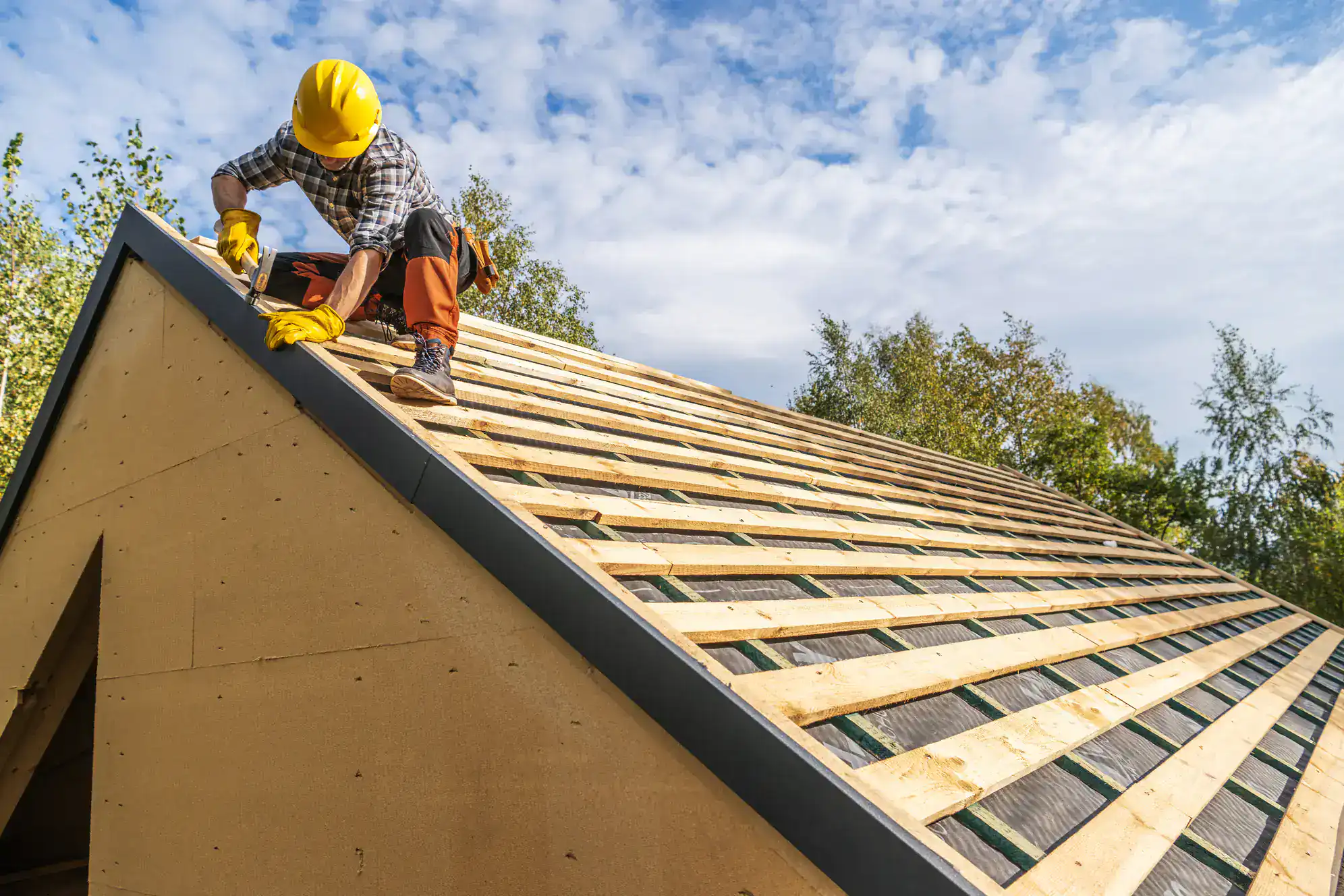
It starts with a free inspection — a real one, not a five-minute glance from the driveway. We go up on the roof, check the surface, the attic, the drainage, the flashing around chimneys and penetrations, and every valley and ridge where water tends to find its way in. You get a detailed photo report at the end of it, regardless of whether you move forward with any work. That report is yours to keep, and if you need it for an insurance claim or an Englewood CCO inspection before a sale, it’s already documented.
From there, you get a clear, itemized estimate before a single nail goes in. The price you approve is the price you pay. If you’ve already collected other bids from local roofing companies in Englewood, NJ, bring them — our beat-or-match guarantee means you don’t have to choose between quality and a fair number.
When work begins, we handle the permit process correctly. Englewood’s Building Department requires permits for roofing work, and pulling them isn’t optional — it’s what protects you legally and keeps the work code-compliant. After the job is done, we clean up the site thoroughly, conduct a final walkthrough with you, and provide warranty documentation before anyone leaves your property.
Ready to get started?
Affordable Roofers in Englewood, NJ
Whether you’re dealing with a single leak, storm damage from a recent nor’easter, or a full roof that’s reached the end of its life, the scope of work is determined by what your roof actually needs — not by what generates the biggest ticket. Englewood’s housing stock runs the full range: modest post-war homes in the Fourth Ward, mid-century Colonials throughout the city’s residential blocks, and architecturally complex Victorian and Tudor Revival properties on East Hill. Each one comes with its own set of roofing challenges, and we adjust our approach accordingly.
For full replacements, we perform a proper tear-off down to the decking, not an overlay that adds weight and hides existing damage. We install code-compliant ventilation, correct flashing at every chimney and wall intersection, and materials matched to the specific demands of Bergen County’s climate — not just whatever’s cheapest to install. Manufacturer-certified installation also means access to system warranties that cover far more than materials alone, and that transfer to future buyers if you sell.
We’re available around the clock for emergency roof repair in Englewood, NJ. When a storm hits on a Friday night and water is coming through a ceiling, 24/7 availability isn’t a marketing line — it’s the only thing that matters. We provide emergency tarping, rapid damage assessment, and insurance documentation support as part of our response.
Do I need a permit to replace my roof in Englewood, NJ?
Yes, and it’s not something to skip. Englewood’s Building Department requires permits for roofing work, and the job needs to comply with New Jersey’s Uniform Construction Code before it can pass inspection. A contractor who tells you permits aren’t necessary — or who suggests skipping them to save time — is creating a liability that lands on you, not them.
The reason this matters beyond code compliance is Englewood’s Certificate of Continued Occupancy requirement. Before a home in Englewood can be sold, the seller has to obtain a CCO, and that process includes a review of the property’s condition. Roofing work done without permits, or work that doesn’t meet current code, can surface during that process and delay or derail a sale. Getting it done right the first time protects your timeline and your equity whenever you decide to move.
How do I know if I need a full roof replacement or just a repair?
That’s genuinely one of the most important questions to get an honest answer to, and it’s also where a lot of homeowners get steered wrong. The short version: age, extent of damage, and the condition of the decking underneath are the three factors that matter most. A roof with isolated damage — a few failed shingles, a flashing issue at a chimney, a valley that’s collecting debris — can often be repaired effectively and extend the life of the system by several years.
Where replacement becomes the right call is when the damage is widespread, when the roof has already been overlaid once and can’t support another layer, or when the underlying decking has taken on moisture and begun to deteriorate. Englewood’s older housing stock — a significant portion of the city’s single-family homes were built between the 1920s and 1960s — means many roofs here are on their second or third generation. A proper inspection will tell you which situation you’re actually in, and a straightforward contractor will give you that answer without pushing you toward the more expensive option if it isn’t warranted.
What does a nor'easter actually do to a roof, and how do I spot the damage?
Nor’easters are the most destructive recurring weather event for residential roofing in Bergen County, and they cause damage in a few distinct ways. The sustained high winds can lift and crack shingles, particularly at the edges and ridgeline where they’re most exposed. The heavy wet snow adds significant weight load, and if drainage is compromised — clogged gutters are common on Englewood’s tree-lined streets — water backs up under the eaves instead of running off cleanly.
The ice dam problem is the one that catches the most homeowners off guard. When snow melts on the warmer upper sections of the roof and refreezes at the colder eaves overnight, it creates a dam that forces liquid water backward under the shingles. That water doesn’t announce itself immediately — it works its way into the attic, the insulation, and eventually the ceiling below, sometimes weeks after the storm that caused it. Signs to watch for after a major storm include water stains on ceilings or upper walls, ice buildup along the roofline, and shingles that look lifted, cracked, or missing granules when viewed from the ground.
How much does a roof replacement cost in Englewood, NJ?
The honest answer is that it depends on the size of the roof, the material being installed, whether the decking needs to be replaced, and the complexity of the roofline. In Bergen County, a standard asphalt shingle replacement on a typical single-family home generally falls somewhere between $10,000 and $20,000, though that range shifts significantly for the larger, more architecturally complex homes you find in parts of Englewood — particularly East Hill properties with steep Victorian pitches, multiple dormers, and intricate flashing requirements.
What affects the number more than most homeowners expect is the condition of what’s underneath. If the decking has water damage, or if the existing installation included an overlay that needs to come off before new shingles can go down, those are real costs that a thorough inspection will surface upfront — not partway through the job. Transparent pricing before work begins means you know the full number before you commit, not after the crew is already on your roof.
Can a roofer in Englewood, NJ help me with my homeowner's insurance claim?
Yes, and having the right contractor involved early in the process can make a meaningful difference in how the claim goes. Insurance adjusters work from documentation — photos of the damage, written assessments of what failed and why, material specifications for what needs to be replaced. A licensed roofing contractor who knows how to document storm damage correctly gives your claim the detail it needs to be processed accurately.
Our free inspection includes a photo report specifically built for this purpose. If you’ve had a storm event — a nor’easter, a hail event, a wind storm that came through Bergen County — and you’re not sure whether the damage rises to the level of a claim, the inspection gives you a clear picture of what’s there before you make that call. It also gives you documentation that stands up if the adjuster’s initial assessment comes in lower than the actual scope of damage warrants.
What should I look for when hiring a local roofing company in Englewood, NJ?
Start with the license. New Jersey requires Home Improvement Contractor registration for any roofing work, and that number should be publicly verifiable through the NJ Division of Consumer Affairs. If a contractor can’t produce it or gets vague when you ask, that’s a clear signal to move on. Insurance — both general liability and workers’ compensation — is equally non-negotiable, because without it, any injury or property damage during the job becomes your problem.
Beyond the basics, manufacturer certifications are worth asking about. Most contractors can install shingles, but a certified installer has met the manufacturer’s training and quality standards, which unlocks access to enhanced system warranties that a non-certified contractor simply cannot offer. In a city where home values average above $600,000 and where the CCO process means your roof’s condition is part of the public record when you sell, the warranty terms attached to your new roof are a real financial consideration — not just a piece of paper in a folder.