
Roof Inspection in Scotch Plains, NJ
Watchung Weather Is Rough. Your Roof Deserves an Honest Look.
Hear from Our Customers
Roof Damage Inspection in Scotch Plains, NJ
Most roof problems don’t announce themselves until water is already inside your home. By then, what started as a failed flashing seal or a few cracked shingles has turned into damaged decking, soaked insulation, and a repair bill that’s significantly higher than it needed to be. A roof inspection catches those problems early — when they’re still manageable.
Scotch Plains homes — especially the mid-century capes, ranches, and split-levels on the south side near Clark and Edison — are at the age where roofs start showing real wear. If your home was built in the 1950s, 1960s, or 1970s and has had one roof replacement, there’s a reasonable chance you’re approaching another decision point. The question is whether you find out on your timeline or the roof’s.
The north side tells a different story. The larger colonials near the Watchung Reservation have more complex rooflines — dormers, valleys, chimneys, multiple flashing points — where small failures compound fast. Those homes benefit from thorough, experienced inspections that go beyond a quick visual scan. Either way, knowing the true condition of your roof is the only way to make a smart decision about what comes next.
Licensed Roof Inspector Serving Scotch Plains, NJ
We’ve been doing exterior work across Scotch Plains and the surrounding Union County region for nearly ten years. Roofing is the core of what we do — not a side service, not an upsell to something else. We hold a valid New Jersey Home Improvement Contractor license and carry certifications from major shingle manufacturers, which means the warranty coverage available to you after any replacement work we do is significantly stronger than what an uncertified contractor can offer.
What actually sets us apart is simpler than credentials. We’ve built this business on reviews and referrals — not advertising — because we tell homeowners the truth. If your roof has five solid years left, we’ll say so. If it needs targeted repairs instead of a full replacement, that’s what we’ll recommend. Scotch Plains is a community where people talk to their neighbors, and we’d rather earn your trust than your signature.

Roof Inspection Company in Scotch Plains, NJ
It starts with a quick conversation. You tell us what you’ve noticed — a water stain on the ceiling, a shingle that came off in the last storm, or just a roof that’s been up there for twenty years and you’re not sure about. We schedule a time that works for you and come out to your Scotch Plains property at no charge.
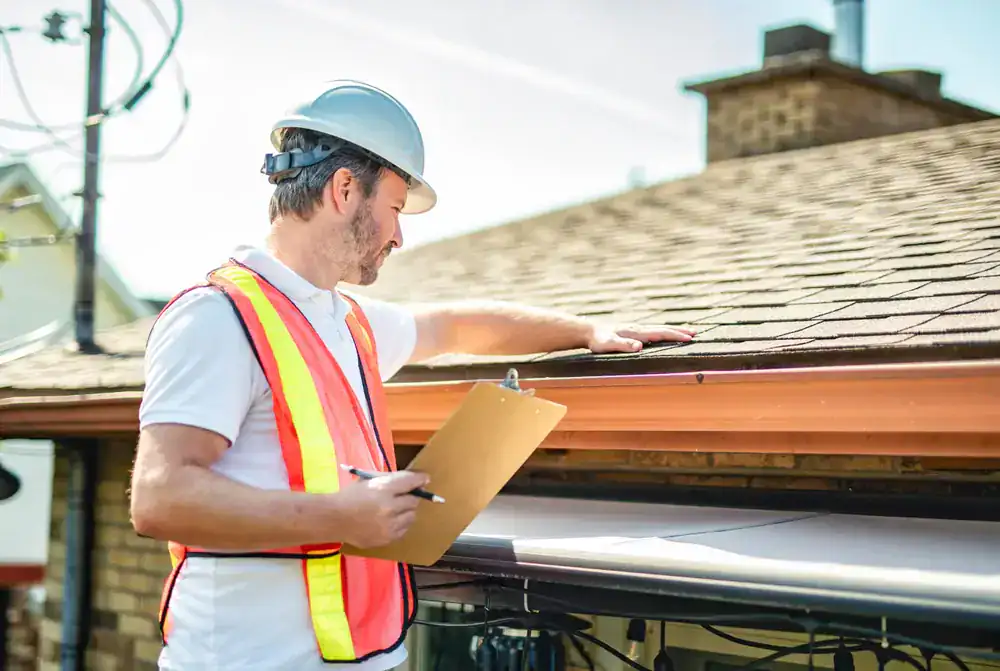
On-site, we do a thorough inspection of your shingles, flashing, ridge cap, valleys, soffits, and any penetrations like chimneys or skylights. We’re not doing a drive-by assessment from the ground — we’re checking the areas where Union County weather actually causes damage. After a nor’easter or a summer hail event, that means looking at granule loss patterns, lifted edges, and flashing displacement that won’t be obvious until a trained eye is up close.
When we’re done, you get a straight answer. If there’s damage, we’ll show you exactly where it is and what it means — including documentation that holds up if you’re filing an insurance claim. If your roof is in good shape, we’ll tell you that too. Scotch Plains Township requires permits for replacement work under New Jersey’s Uniform Construction Code, and every project we take on is handled within that framework — so you’re protected from the liability that comes with unlicensed work, both now and at resale.
Ready to get started?
Certified Roof Inspector in Scotch Plains, NJ
A roof inspection from us isn’t a formality — it’s a working assessment of your home’s first line of defense. We look at every component that affects how your roof performs: shingles, flashing at all penetrations and transitions, ridge and hip caps, soffit and fascia condition, gutter attachment points, and the visible decking structure where accessible. Because we also handle gutters and siding, a single visit can give you a complete picture of your exterior — not just the roof in isolation.
For Scotch Plains homeowners dealing with the aftermath of a storm, we produce detailed inspection reports with photographic documentation. If you’re working through an insurance claim after a nor’easter or a hail event, the difference between a report from a licensed, manufacturer-certified contractor and a general assessment from an unlicensed operator can be the difference between a claim that moves forward and one that stalls. Insurance adjusters take documented, professional reports seriously — and that’s exactly what we provide.
If the inspection reveals that replacement is the right call, your manufacturer certification access matters here. Certifications from programs like GAF Master Elite or CertainTeed SELECT ShingleMaster unlock enhanced warranty tiers that uncertified contractors simply can’t offer. For a home in a market as strong as Scotch Plains — where buyers scrutinize every inspection report — that warranty is a real, transferable asset.

Does Scotch Plains require a permit for roof replacement work?
Yes. Scotch Plains Township requires a construction permit for roof replacement under New Jersey’s Uniform Construction Code. This isn’t optional — and it’s not just a formality. The township’s Building Department explicitly warns homeowners that hiring unlicensed contractors who skip the permit process can result in legal and financial liabilities, including complications with your homeowner’s insurance coverage.
What that means practically is that if unpermitted work is discovered during a future sale or insurance claim, you could be on the hook for it — even if you didn’t pull the permit yourself. Working with us means every replacement project in Scotch Plains is permitted and inspected through the proper channels. That protects your investment now and removes a potential deal-killer when it’s time to sell.
How do I know if my roof was actually damaged after a storm?
This is one of the most common questions we hear after a major weather event, and the honest answer is: you probably can’t tell from the ground. Hail damage, granule loss, lifted shingle edges, and flashing displacement are the kinds of issues that don’t show up as obvious visual damage from the street — but they absolutely shorten your roof’s lifespan and create entry points for water.
After a nor’easter or a significant summer thunderstorm in Scotch Plains, the smart move is to have a licensed roof inspector take a close look before you assume everything is fine. If there is storm damage, you want it documented by a certified professional before you contact your insurance company — not after. A well-documented inspection report from a licensed contractor carries real weight with adjusters and gives you a much stronger starting point for any claim.
What does a roof inspection in Scotch Plains, NJ typically cost?
With us, the inspection is free. No service charge, no trip fee, no obligation to hire us for anything afterward. You get a full assessment of your roof’s condition at no cost, and whatever you decide to do with that information is entirely up to you.
The reason we do it this way is straightforward: we’d rather earn your business by showing you what we know than charge you for the privilege of finding out. If your roof needs work, we’ll tell you what it needs and what it costs. If it doesn’t, we’ll tell you that too. For Scotch Plains homeowners who are already managing the costs of maintaining a home in Union County, removing the financial barrier to getting an honest assessment just makes sense.
How often should a Scotch Plains homeowner schedule a roof inspection?
For most homes, a professional inspection every two to three years is a reasonable baseline — but Scotch Plains has some specific factors that push that number toward the more frequent end. The freeze-thaw cycling that Union County experiences through the winter months is particularly hard on flashing sealants and shingle edges. Water gets into minor imperfections, freezes, expands, and widens the gap. By the time spring arrives, what was a hairline issue in October can be a meaningful entry point for water.
If your home is on the older end of Scotch Plains’s housing stock — particularly the mid-century ranches and split-levels on the south side — an annual inspection is worth considering as you approach the end of your roof’s expected lifespan. And after any significant weather event, a post-storm inspection is always a smart call regardless of when your last one was.
Can a roof inspection help if I'm preparing to sell my home in Scotch Plains?
Absolutely — and it’s one of the most underused tools in a pre-listing strategy. Scotch Plains has a strong real estate market, and buyers here are informed. When a buyer’s home inspector flags a roofing issue, it almost always becomes a negotiating point — either a price reduction, a repair credit, or a deal that falls apart entirely. A pre-listing roof inspection gives you the chance to identify and address those issues on your terms, before a buyer’s inspector finds them.
It also gives you documentation to share with prospective buyers — a recent inspection report from a licensed, manufacturer-certified contractor signals that the home has been well-maintained and that the roof isn’t a hidden liability. In a market where buyers are comparing multiple properties, that kind of transparency builds confidence and keeps deals moving. The inspection is free, and the information it gives you before you list is genuinely valuable.
What's the difference between a licensed and unlicensed roof inspector in New Jersey?
In New Jersey, a Home Improvement Contractor license issued through the Division of Consumer Affairs is the legal baseline for anyone performing roofing work on a residential property. A licensed contractor carries the required insurance, operates under New Jersey’s consumer protection framework, and gives you legal recourse under the Consumer Fraud Act if something goes wrong. An unlicensed operator offers none of that.
For Scotch Plains homeowners specifically, this distinction has real consequences. The township’s own Building Department warns that hiring unlicensed contractors can affect your homeowner’s insurance coverage and create liability at the point of resale. Beyond the legal exposure, an unlicensed inspector’s assessment carries no weight with an insurance adjuster — which matters enormously if you’re filing a storm damage claim. When you’re making decisions about one of the most significant components of your home, the person assessing it should be someone whose license, insurance, and reputation are actually on the line.
Other Services we provide in Scotch Plains