
Roof Inspection in Ridgefield Park, NJ
Old Homes, River Air, and Roofs That Can't Afford to Wait
Hear from Our Customers
Certified Roof Inspector in Ridgefield Park, NJ
When you schedule a roof inspection, you’re not just checking a box. You’re finding out whether the roof over your family is doing its job — before a ceiling stain, a rotted deck, or a surprise $15,000 replacement forces the conversation.
Ridgefield Park’s peninsular location along the Hackensack River creates elevated moisture conditions that accelerate granule loss, feed moss and algae growth, and quietly compromise flashing sealants on homes that were already aging before most people’s parents were born. A trained eye catches what you can’t see from the driveway — lifted shingles, micro-cracks around chimney bases, failing soffit ventilation — and tells you whether it’s a $400 repair or something that genuinely needs more attention.
The other thing you get is clarity. If your roof has years of life left, you’ll hear that. If it’s borderline, you’ll know what to watch. And if it needs work, you’ll get a straight answer about what and why — not a sales pitch designed to move you toward the biggest invoice possible. That’s the difference a licensed roof inspection in Ridgefield Park makes for a homeowner who has real money invested in a real home.
Licensed Roof Inspector in Ridgefield Park, NJ
We’ve been working on New Jersey homes for over ten years. Bergen County’s aging housing stock, its nor’easter seasons, and the specific wear patterns that come with river-adjacent living aren’t abstract concepts to us — they’re what we see on rooftops across Ridgefield Park and neighboring communities every week.
We hold a New Jersey Home Improvement Contractor license and carry certifications from major shingle manufacturers — credentials that fewer than 3% of roofing contractors in the country earn. That matters because certified contractors can offer manufacturer-backed warranty coverage that unlicensed or uncertified competitors simply cannot provide. Your warranty doesn’t have to be a question mark.
We’re a family-run business, which means the people doing the work are the same people whose name is on every review. There’s no middleman between you and accountability. Homeowners in Ridgefield Park talk to their neighbors — and we’ve built this business on what those conversations sound like after the job is done.

Roof Inspection Company in Ridgefield Park, NJ
It starts with a call or a form submission. You tell us what you’re seeing — or not seeing, because a lot of roof problems aren’t visible until they’ve already caused damage. We get you scheduled, usually quickly, and we come to you. No drop-off, no waiting on a quote before we’ll show up.
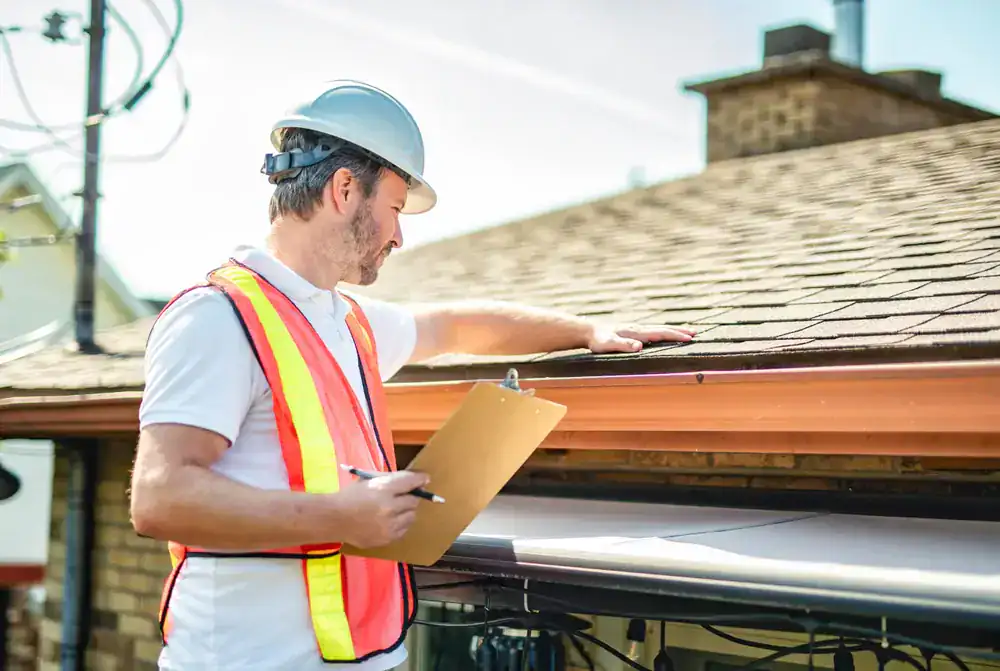
On inspection day, a certified inspector walks your entire roof — not just the obvious spots. We check shingles for granule loss, curling, and impact damage. We examine flashing at every transition point: chimney bases, vent pipes, valleys, and eave edges. We look at soffit and fascia condition, gutter attachment, and attic ventilation, because poor ventilation is one of the leading causes of premature shingle failure in older Ridgefield Park homes. If there’s been a recent nor’easter or a summer hail event — both common in Bergen County — we specifically document any storm-related damage with photographs that hold up in an insurance claim.
After the inspection, you get a clear summary of findings. If the Village of Ridgefield Park’s Building Department requires a permit for any work we recommend — and they do require one for roof replacement — we handle that process correctly. You won’t be left navigating the municipal paperwork at 234 Main Street on your own. Everything is documented, explained, and handed to you in plain language.
Ready to get started?
Roof Damage Inspection in Ridgefield Park, NJ
A roof inspection from us covers the full exterior system — not just the shingles. We assess every component that affects whether water stays outside your home: shingle condition and remaining life expectancy, flashing integrity at all penetration and transition points, gutter attachment and drainage, soffit and fascia condition, ridge cap and hip detail, and attic ventilation adequacy.
For homes near the Hackensack River waterfront edges of Ridgefield Park, we pay specific attention to moss, algae, and moisture-driven granule loss — because that kind of wear happens faster here than it does in landlocked Bergen County towns. For homes that have been through a significant storm, we document hail impact craters, wind-lifted tabs, and any areas where water has already begun infiltrating the deck. That documentation matters if you’re filing or considering an insurance claim, because our inspection represents your interests — not the carrier’s.
Because the majority of Ridgefield Park’s housing stock was built before 1960, we also look at flashing details and ventilation configurations common to that era of construction — the failure points that newer-home inspectors sometimes miss entirely. Whether you need a roof leak inspection after a wet winter, a pre-listing assessment before putting your home on the market, or a routine check on a roof that’s getting up in age, the scope of what we cover doesn’t change. You get a thorough, documented, honest assessment every time.

Do I need a permit to replace my roof in Ridgefield Park, NJ?
Yes — the Village of Ridgefield Park requires a building permit before any roof replacement begins. The Building Department is located at 234 Main Street and enforces the New Jersey State Uniform Construction Code, which applies to all roofing work in the village. Skipping the permit process isn’t just a technicality — it creates real problems. Unpermitted work can complicate a future home sale, create issues with your homeowner’s insurance, and strip away your legal protections under New Jersey’s Consumer Fraud Act.
When we perform a roof inspection and replacement work follows, we handle the permit process as part of the job. You don’t need to figure out what forms to pull or what inspections to schedule — we manage it. Working with a properly licensed New Jersey Home Improvement Contractor means the paperwork is done right the first time, and the finished work is documented correctly for your records and your home’s history.
How do I know if my roof has hail damage after a Bergen County storm?
Hail damage to asphalt shingles is almost never visible from the ground. What hail actually does is knock granules off the surface of the shingle — those granules are what protect the asphalt layer underneath from UV exposure and moisture. Once they’re gone from a concentrated area, the shingle starts degrading faster, but it may not show up as an interior leak for months or even a year or two. By the time you see a ceiling stain, the damage has been compounding for a while.
Bergen County experiences frequent severe thunderstorms that produce damaging hail, and Ridgefield Park’s location — exposed on multiple sides due to its peninsula position along the Hackensack River — means wind-driven storms hit the village from more than one direction. After a significant weather event, a roof damage inspection is the only reliable way to document what actually happened. We photograph every point of impact, which gives you a clear record for an insurance claim and a baseline for understanding how much life your roof realistically has left.
What causes ice dams, and are Ridgefield Park homes especially at risk?
Ice dams form when heat escapes through your attic and warms the roof deck, melting snow that then runs down to the cold eaves and refreezes. That ice buildup creates a barrier that forces water to back up under your shingles — and once water is under the shingles, it has a direct path to your roof deck, your insulation, and eventually your ceiling.
Ridgefield Park’s pre-WWII and mid-century housing stock is particularly vulnerable because older homes were often built without the attic ventilation and insulation standards that reduce ice dam risk. If your home was built before 1960 — and the majority of homes in this village were — there’s a reasonable chance the attic configuration is contributing to the problem every winter. Bergen County’s freeze-thaw cycles compound this: temperatures regularly cross the 32°F threshold multiple times throughout the winter, meaning the melt-and-refreeze cycle happens repeatedly across a single season. We can assess your ventilation setup and identify whether ice dam vulnerability is something you need to address before next winter.
How often should a Ridgefield Park homeowner schedule a roof inspection?
The standard recommendation from roofing industry professionals is twice a year — once in the spring after winter weather has run its course, and once in the fall before nor’easter season begins. For most Ridgefield Park homeowners, that cadence makes practical sense given what Bergen County winters actually do to a roof.
That said, event-triggered inspections matter just as much as scheduled ones. If there’s been a significant hail storm, a nor’easter with sustained high winds, or any period of heavy sustained rainfall, it’s worth having us take a look — even if your last scheduled inspection was recent. The same applies if your home is older and hasn’t been inspected in several years, which is more common than people realize in a village where most of the housing stock dates back several decades. Roofing material costs have risen significantly in recent years, which makes early detection and minor repair far more economical than a delayed full replacement. The inspection itself is free — the cost of waiting is what adds up.
Can a roof inspection help with my homeowner's insurance claim in NJ?
It can — and in many cases, it’s the most important step you take before or during the claims process. When you file a storm damage claim, your insurance company sends an adjuster whose job is to assess damage on behalf of the carrier. We document damage on your behalf — which is a fundamentally different perspective.
A thorough inspection report with photographs of every damage point gives you documentation that is specific, detailed, and defensible. It ensures that nothing gets minimized or overlooked in the adjuster’s assessment. In Bergen County, where nor’easters and summer hail events regularly generate insurance claims across entire neighborhoods, having your own documented inspection can be the difference between a claim that covers the actual scope of the damage and one that falls short. We produce inspection reports specifically designed to hold up in the claims process — not just a verbal summary, but a written record you can submit and reference throughout the claim.
What should I look for when choosing a roof inspection company in Ridgefield Park, NJ?
Start with licensing. Any contractor working on homes in Ridgefield Park should hold a valid New Jersey Home Improvement Contractor registration — this is a legal requirement, and it’s the baseline that gives you protection under New Jersey’s Consumer Fraud Act if something goes wrong. You can verify a contractor’s registration through the NJ Division of Consumer Affairs before you ever let anyone on your roof.
Beyond licensing, manufacturer certification is worth asking about specifically. Certified contractors — those who have earned credentials from major shingle manufacturers — can offer warranty coverage that uncertified contractors cannot. In a village where homes are aging and roofing systems aren’t cheap to replace, maximizing your warranty protection is a real financial consideration, not a sales point. Finally, look at how a company communicates. Do they explain what they found in plain language? Do they tell you when a repair is sufficient instead of defaulting to replacement? A roof inspection should leave you with more clarity than you had before — not more anxiety. If the inspector can’t explain their findings clearly, that’s worth paying attention to before you agree to any work.