Hear from Our Customers
You’re not dealing with gutters because you want to. You’re dealing with them because water is pooling around your foundation, splashing mud on your siding, or worse—leaking into your basement. In Fanwood, where homes average 70 years old and sit on clay-rich soil that holds water like a sponge, your gutter system isn’t optional.
Properly installed gutters reduce basement moisture problems by 76%. That’s not marketing talk—that’s what happens when rainwater gets directed away from your foundation instead of soaking into it. No more hydrostatic pressure pushing through foundation walls. No more emergency calls when the next storm rolls through.
The average basement flooding repair in New Jersey costs $4,300. Water damage claims average over $11,000. Professional gutter installation costs a fraction of that and handles the problem before it starts. You get a system that works during the 43-47 inches of rain Fanwood sees every year, not one that fails when you need it most.
We’ve spent ten years installing gutters and handling exterior renovations for homeowners throughout Union County. We’re licensed contractors with certifications from major manufacturers, and we focus primarily on roofing—which means we understand how your entire water management system works together.
We’re a family-owned business, not a national chain. When you call, you’re talking to people who live and work in this area. We know what Fanwood homes deal with: older construction, mature trees, heavy spring rains, and the kind of weather that tests your gutters twice a year.
You’ll get a free estimate with transparent pricing. No pressure, no runaround. Just a clear explanation of what your home needs and what it’ll cost.
We start with a free inspection of your home’s roofline, drainage patterns, and current gutter situation. We’re looking at how water flows off your roof, where it’s going now, and where it should go. We measure your roofline and calculate how many downspouts you need based on your roof’s square footage and pitch.
Then we give you a detailed estimate. You’ll know exactly what materials we’re using—typically aluminum seamless gutters that we form on-site to fit your home’s exact measurements. We’ll explain the gauge thickness, the size (5-inch or 6-inch), and why we’re recommending what we’re recommending. Most installations in Fanwood run $5-12 per linear foot depending on your home’s height, accessibility, and the system you choose.
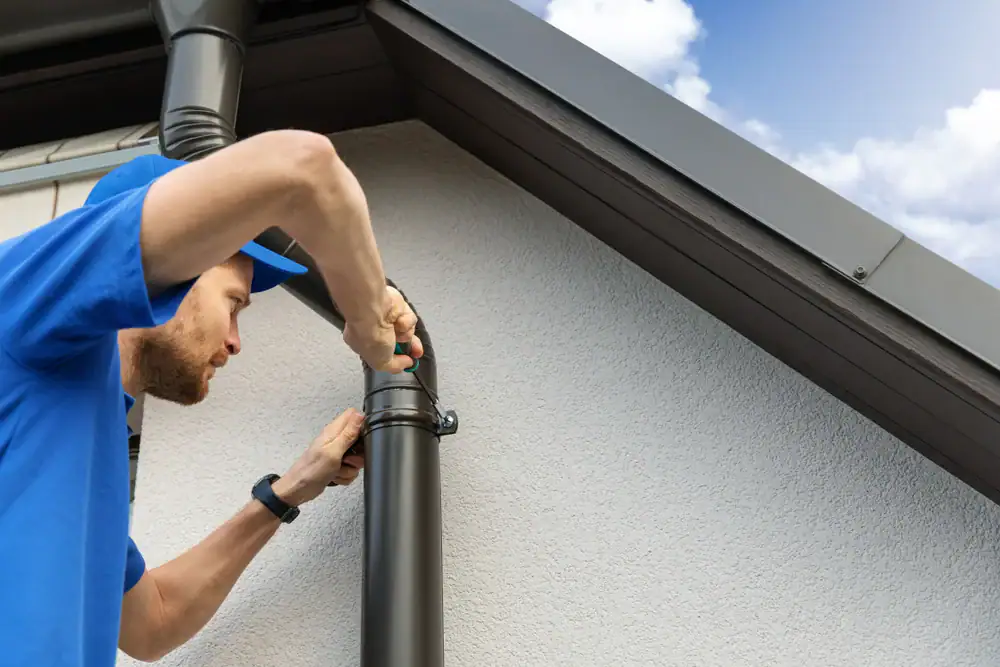
Installation day, we remove your old gutters if needed, install the new seamless system, and make sure every downspout directs water at least 6-10 feet away from your foundation. We test the flow, check the pitch, and clean up completely. You’re left with a system that’s ready for the next storm—and the one after that.
Ready to get started?
Seamless aluminum gutters are the standard for good reason. They’re formed on-site to your home’s exact measurements, which means fewer seams and fewer potential leak points. Seams only exist at corners and downspout outlets—not every ten feet like sectional gutters. That’s why they last longer and perform better.
In Fanwood, where you’re dealing with significant rainfall and older homes with valuable foundations, most installations use 6-inch gutters instead of the standard 5-inch. Oversized gutters handle heavier water volume during storms and reduce overflow risk. Your roof might dump a lot of water in a short time—especially during spring thunderstorms or rapid snowmelt—and your gutters need to keep up.
Downspout placement matters more than most homeowners realize. We calculate the right number based on your roof area and position them to move water away from foundation walls, basement windows, and landscaping. Extensions and splash blocks aren’t optional add-ons—they’re part of making sure water actually leaves your property instead of pooling next to your foundation.
You’ll also get options for gutter guards if you’re tired of cleaning leaves out twice a year. With Fanwood’s mature tree canopy, guards can cut your maintenance burden significantly. We’ll explain what works and what doesn’t—because not all gutter protection systems are worth the money.
Most homes in Fanwood run between $1,200 and $3,000 for a complete seamless gutter installation, depending on your home’s size and the system you choose. The typical range is $5-12 per linear foot. A standard single-family home with 150-200 linear feet of roofline usually falls in the $1,500-2,000 range for quality aluminum seamless gutters.
Price varies based on a few factors: your home’s height (two-story installations cost more), accessibility (steep roofs or tight spaces add labor time), gutter size (6-inch costs more than 5-inch), and whether you’re adding gutter guards. If we’re removing old gutters first, that adds to the total.
We give you a detailed written estimate after inspecting your home, so you’ll know exactly what you’re paying for. No surprises, no hidden fees. And when you compare that cost to the $4,300 average for basement flooding repairs or the $8,000+ for foundation work, professional installation pays for itself the first time it prevents water damage.
Most gutter installations take one day—typically 4-8 hours depending on your home’s size and complexity. We show up in the morning, and you have fully functional gutters by late afternoon. You don’t need to be home the entire time, though we’ll need access to your property and exterior outlets.
The process is straightforward: we set up our equipment, remove old gutters if necessary, install the new seamless system, attach downspouts, and test everything before we leave. You’ll hear some noise during installation—cutting, drilling, and general construction sounds—but it’s not disruptive like interior renovations.
We clean up completely when we’re done. No gutter debris left in your yard, no nails in your driveway. You can use your home normally during installation—we’re working outside, so your daily routine isn’t affected. Most homeowners are surprised how quick and clean the process is compared to other home improvement projects.
For most Fanwood homes, 6-inch gutters are worth the upgrade. New Jersey gets 43-47 inches of precipitation yearly, and spring storms can dump heavy rainfall in short periods. Larger gutters handle higher water volume without overflowing, which matters when your roof is channeling a lot of water into a small space.
The difference comes down to capacity. Six-inch gutters hold roughly 50% more water than 5-inch gutters. During heavy downpours—the kind where water sheets off your roof—that extra capacity prevents overflow that defeats the entire purpose of having gutters. Overflow means water still lands next to your foundation, splashes on your siding, and creates the exact problems you’re trying to avoid.
The cost difference is minimal—usually $1-2 more per linear foot—but the performance difference is significant. If your home has a steep roof pitch, a large roof area, or you’re dealing with mature trees that shed debris, 6-inch gutters are the smarter choice. We’ll assess your specific situation during the estimate and recommend what actually makes sense for your home.
Seamless gutters are formed on-site from a single piece of material cut to your home’s exact measurements. Sectional gutters come in pre-cut pieces (usually 10 feet long) that get joined together with connectors and sealant. The key difference is leak potential: every seam is a potential failure point.
Sectional gutters have seams every 10 feet, plus at corners and downspouts. Over time, those seams separate as sealant degrades, connectors loosen, and thermal expansion takes its toll. You end up with leaks that require constant maintenance. Seamless gutters only have seams at corners and downspout outlets—dramatically fewer weak points.
Seamless systems also look cleaner and last longer. They’re custom-fit to your home, so there’s no guessing about measurements or dealing with ill-fitting sections. The upfront cost is slightly higher than sectional gutters, but you save money over time through reduced maintenance and fewer repairs. For homes in Fanwood’s price range—where the median value tops $730,000—seamless is the standard, not the upgrade.
Working gutters move water off your roof and away from your foundation without overflowing, leaking, or pooling. The easiest test is watching them during a rainstorm. Water should flow smoothly through the gutters toward downspouts, exit through the downspouts, and get directed at least 6-10 feet away from your foundation.
Red flags include water overflowing the gutter edges (means they’re clogged or undersized), water dripping from seams or joints (means they’re leaking), standing water in sections after rain stops (means the pitch is wrong), and water pooling near your foundation (means downspouts aren’t extended properly). Inside your home, basement moisture, foundation cracks, or water stains on exterior walls often trace back to gutter problems.
You should also check for physical damage: sagging sections, gutters pulling away from fascia boards, rust spots, or visible holes. In Fanwood, where homes deal with freeze-thaw cycles and heavy leaf debris from mature trees, gutters take a beating. If your system is over 20 years old or showing multiple issues, replacement usually makes more sense than patching problems one at a time.
Gutter guards are worth it if you have significant tree coverage and you’re tired of cleaning gutters twice a year—which is what Fanwood homes with mature trees require. Good guards reduce maintenance frequency and prevent clogs that cause overflow. Bad guards waste your money and create new problems.
The key is choosing the right type. Mesh guards and micro-mesh systems work well for keeping out leaves and debris while allowing water through. Cheap snap-on screens often trap debris on top and still require cleaning. Reverse-curve systems can be effective but sometimes cause water to overshoot during heavy rain. We’ll recommend what actually works based on your tree situation and roof pitch.
Expect to pay $7-12 per linear foot for quality gutter guard installation. For a typical Fanwood home, that’s $1,000-2,000 added to your gutter project. It’s not cheap, but if you’re paying $100-300 annually for professional gutter cleaning—or spending your weekends on a ladder—guards pay for themselves in 3-5 years. They also prevent the clogs that lead to overflow, ice dams, and the water damage you installed gutters to avoid in the first place.