
Roof Inspection in Madison Hill, NJ
Madison Hill's 1950s Homes Need a Smarter Inspection
Hear from Our Customers
Certified Roof Inspector in Madison Hill, NJ
The homes along Madison Hill Road were built around 1951. Even if your roof was replaced in the 1990s or early 2000s, you’re looking at a system that’s 20 to 30 years into its lifespan — right at the window where things start to quietly fail. Shingles don’t announce themselves when they’re done. Water finds its way in long before you see a stain.
A professional roof inspection gives you a clear, documented picture of what’s actually happening up there. Not a guess. Not a sales pitch. A real assessment of your shingles, flashings, valleys, and ventilation — so you can make a smart decision about what comes next.
For homeowners in Madison Hill, that matters even more. The freeze-thaw cycles Union County gets every winter put serious stress on flashings and shingle edges. The bi-level and split-level homes that define this neighborhood have multiple roof planes and level transitions where water infiltration tends to start. If it’s been more than a year since anyone’s been on your roof, there’s a good chance something has changed.
Licensed Roof Inspector in Madison Hill, NJ
We’ve been working on homes across Union County for over ten years. That means we’ve inspected the Cape Cods, bi-levels, and post-war Colonials that make up the Madison Hill streetscape — and we know the specific failure patterns those homes develop over time.
We’re fully licensed as a New Jersey Home Improvement Contractor, carry general liability and workers’ compensation insurance, and hold certifications from major shingle manufacturers. Those certifications matter because they unlock enhanced warranty coverage that most contractors simply can’t offer. When a home near the Clark Historical Society on Madison Hill Road is worth close to $770,000, that kind of protection isn’t a minor detail.
What sets us apart is straightforward: we tell you what we find. If your roof has years of life left, we’ll say so. If it needs attention, we’ll show you exactly where and why.

Roof Damage Inspection in Madison Hill, NJ
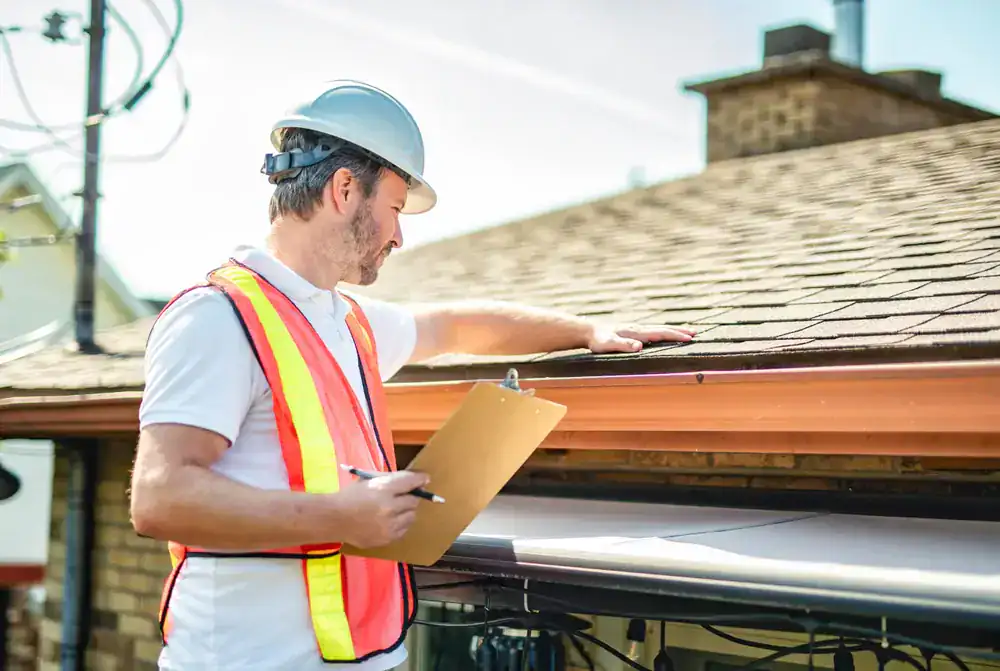
It starts with a call or a form submission. From there, we schedule a time that works for you — no vague windows, no chasing someone down for a callback. When our inspector arrives, they go up on the roof and do a full physical assessment. That means shingles, flashings at every penetration point, valleys, ridge lines, gutters, and ventilation. Nothing gets skipped because it’s inconvenient to reach.
For Madison Hill’s bi-level and split-level homes, that multi-plane inspection is especially important. The transitions between roof levels are exactly where water finds its entry point, and those areas require hands-on assessment — not a drive-by look from the ground.
After the inspection, you get a clear summary of what was found. If there’s damage, you’ll know what it is, where it is, and what your options are. If New Jersey’s permitting process applies to any recommended work — and for a full replacement in Madison Hill, it does — we’ll walk you through what’s required so nothing catches you off guard. The whole thing is free, and there’s no obligation attached to the report.
Ready to get started?
Roof Inspection Company in Madison Hill, NJ
A roof inspection from us isn’t a quick look at the shingles from a ladder. It’s a comprehensive assessment of your entire roofing system — shingles, underlayment condition, flashings at chimneys, skylights, and vents, ridge and soffit ventilation, gutters and fascia, and any visible decking concerns at the eaves or valleys.
In Madison Hill specifically, that gutter and drainage review carries real weight. The area sits within the Rahway River watershed, which means storm water management is a genuine community concern. When gutters fail or roof drainage backs up during a heavy rain event, the consequences move fast. Getting ahead of those issues is part of what a thorough inspection is designed to do.
If you’re preparing to sell your home, dealing with an insurance claim after a nor’easter or summer storm, or simply haven’t had eyes on your roof since the last time someone replaced it, this inspection gives you the documentation you need. For insurance purposes especially, a written report from a licensed, manufacturer-certified contractor carries far more weight with an adjuster than a homeowner’s photos. The inspection is free. The report is yours to keep.

How do I know if my Madison Hill home actually needs a roof inspection right now?
The honest answer is that most homeowners in Madison Hill are overdue without knowing it. If your home was built in the 1950s — which describes the majority of properties on Madison Hill Road — and you haven’t had a professional inspection in the last two to three years, you’re operating without current information on one of the most expensive systems in your house.
You don’t need to see a leak to have a problem. Granule loss, cracked or curling shingles, compromised flashings, and early-stage decking deterioration are all things that don’t show up inside your home until they’ve already caused significant damage. Union County’s winters add another layer — freeze-thaw cycles stress shingle edges and flashings every season, and that cumulative wear is exactly what a trained inspector is looking for. A free inspection costs you nothing and gives you real answers.
What does a roof inspection actually include, and how long does it take?
A thorough roof inspection covers the full system — not just the shingles. That includes the condition of all flashings at penetration points like chimneys, vents, and skylights; the ridge line and hip areas; valleys where two roof planes meet; soffit and ridge ventilation; gutters and fascia; and any visible signs of decking damage at the eaves or low-slope sections.
For the bi-level and split-level homes common in Madison Hill, the inspection also pays close attention to the transitions between roof levels, since those junctions are where water infiltration typically begins. From start to finish, most inspections take between 45 minutes and an hour and a half depending on the size and complexity of your roof. You’ll have a clear summary of findings before our inspector leaves your property.
Does a roof inspection in Madison Hill require a permit, and what about replacement work?
The inspection itself does not require a permit. A licensed inspector can assess your roof without any involvement from the local Construction Department.
Where permits come into play is with the work that follows. Under New Jersey’s Uniform Construction Code, a full roof replacement does require a building permit. Any contractor performing that work must be registered as a New Jersey Home Improvement Contractor with the Division of Consumer Affairs — and if they’re not, you lose your legal protections under the Consumer Fraud Act, and your insurance claim can be complicated if the work isn’t properly documented. We hold full NJ HIC registration, so if a replacement is recommended after your inspection, the permitting process is handled correctly from the start.
Can a roof inspection help with an insurance claim after storm damage in Madison Hill?
Yes — and the quality of your inspection report can directly affect the outcome of your claim. Insurance adjusters are experienced at identifying gaps in documentation, and a vague or incomplete damage report gives them room to minimize or deny a claim.
A written inspection report from a licensed, manufacturer-certified contractor carries significantly more credibility than homeowner photos or a verbal account of what happened. It documents the specific damage, its location, and its likely cause — which is exactly what an adjuster needs to process a legitimate claim. Union County gets its share of nor’easters, tropical storm remnants, and summer hail events, and after any of those, getting a professional inspection on record quickly is the smartest move a Madison Hill homeowner can make.
How does the freeze-thaw cycle in Madison Hill affect my roof over time?
Union County’s winters aren’t extreme by Northeast standards, but the freeze-thaw pattern is actually more damaging to roofing materials than consistent cold. When temperatures cross back and forth over 32 degrees repeatedly throughout the season — which is typical for Madison Hill — shingles expand and contract, flashings work loose at their edges, and any small gap in the system becomes an entry point for water.
Ice dams are the most visible symptom of this. They form when heat escaping through the roof deck melts snow above, which then refreezes at the cold overhang. The water pooling behind that ice dam has nowhere to go but under your shingles. By the time you see a water stain inside your home in March or April, the damage has usually been building since January. A post-winter inspection is one of the most practical things a Madison Hill homeowner can do each spring.
Is a roof inspection worth doing before listing a home for sale in Madison Hill, NJ?
For the Madison Hill market, it’s one of the smartest moves you can make before listing. With median home values around $766,000 in this neighborhood, buyers are coming in with experienced home inspectors who are thorough. If your roof has an issue, it will be found — and at that point, you’re either renegotiating the price under pressure or scrambling to get work done on a tight timeline.
Getting a roof inspection before you list puts you in control of that conversation. If the roof is in good shape, you have documentation to back that up. If there’s a repair needed, you can address it on your own terms and price the home accordingly. Either way, you’re not getting blindsided at the worst possible moment in the transaction. For a home on Madison Hill Road, that kind of preparation isn’t overcautious — it’s just good math.
Other Services we provide in Madison Hill