
Roof Inspection in Cragmere Park, NJ
Cragmere Park Roofs Work Hard — Here's What's Actually Up There
Hear from Our Customers
Roof Damage Inspection in Bergen County
Most homeowners in Cragmere Park don’t find out their roof has a problem until water shows up on the ceiling. By that point, what started as a flashing issue or a few lifted shingles has had months — sometimes a full winter — to work its way into the decking, the insulation, and the interior. A proper roof inspection stops that cycle before it starts.
Cragmere Park sits at roughly 515 feet above sea level, which sounds like a footnote until you’ve lived through a Bergen County winter up here. That elevation means more snow accumulation, colder temps that hold longer, and more freeze-thaw cycles than most of the county deals with. Every one of those cycles stresses your flashing, loosens granules, and creates the conditions that lead to ice dams — those ridges of ice at your roof’s edge that force meltwater back under your shingles. You won’t see that damage from the driveway. A certified roof inspector will.
Then there’s the tree situation. The mature canopy that makes Cragmere Park feel like a park also means constant debris on your roof — leaves, twigs, seed pods sitting in your gutters and on your shingles, holding moisture, feeding moss and algae growth, quietly lifting granules and shortening the life of your roof. After a thorough inspection, you walk away knowing exactly what’s happening up there, what needs attention now, and what can wait.
Licensed Roof Inspector in Cragmere Park, NJ
USA Home Remodeling has been serving northern New Jersey homeowners for over ten years, with deep experience across Cragmere Park and the surrounding Bergen County neighborhoods. We’re family-operated, which means the people doing the work have a personal stake in how it goes. No subcontracting surprises. No inflated scopes. Just a straightforward assessment from a team that’s been inspecting roofs across this area long enough to know what Cragmere Park winters actually do to a roofing system.
We hold contractor licenses and certifications from major shingle manufacturers — credentials that a small fraction of roofers in New Jersey carry and that allow us to offer manufacturer-backed warranty coverage that uncertified contractors simply can’t provide. For homeowners in Cragmere Park, where the median property value sits above $650,000, that kind of warranty protection is worth knowing about before you make any decisions.
The inspection is free. There’s no obligation, no pressure, and no manufactured urgency. If your roof is fine, you’ll hear that. If something needs attention, you’ll get a clear explanation and a documented report you can actually use.

Roof Inspection Company in Cragmere Park
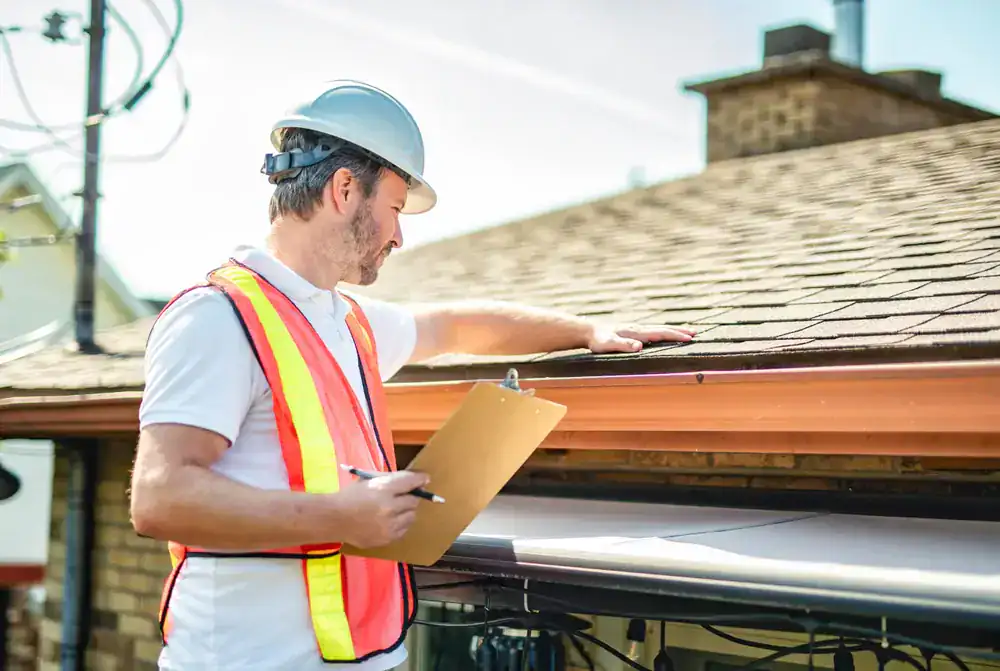
It starts with a quick call or form submission. You tell us what you’re seeing — or what you’re not sure about — and we schedule a time that works for you. The inspection itself doesn’t take long, but it’s thorough. We go up on the roof, not just around it. That means checking shingle condition, flashing at every penetration point, ridge cap integrity, soffit and fascia, gutter attachment, and any signs of moss, algae, or debris buildup — all of which are common concerns on the older homes and wooded lots throughout Cragmere Park.
If you’re in one of the neighborhood’s pre-1940 or mid-century homes, we’ll also look at attic ventilation, because inadequate ventilation is one of the most common hidden drivers of premature shingle failure in older Bergen County homes. It accelerates deterioration from below in ways that aren’t obvious until the damage is already significant.
After the inspection, you get a clear summary of findings with photos. If any work is needed and you want to move forward, Mahwah Township requires a construction permit for full roof replacements — pulled by a licensed New Jersey Home Improvement Contractor. We handle that process. If you’re filing an insurance claim for storm damage, the documented inspection report is what you’ll need to support it. Everything is handled in order, without shortcuts.
Ready to get started?
Certified Roof Inspector in Cragmere Park, NJ
A roof inspection from USA Home Remodeling isn’t a drive-by visual check. We go up on the roof and work through the full system — shingles, flashing at chimneys and dormers, valley seams, ridge caps, vent pipe boots, soffit and fascia condition, and gutter attachment points. On the older homes that make up a significant portion of Cragmere Park’s housing stock, that also means evaluating attic ventilation and checking for signs of moisture infiltration in the decking. These are the things that a ground-level glance misses entirely.
Because Cragmere Park sits in the shadow of the Ramapo Mountains and deals with heavier winter conditions than most of Bergen County, the inspection pays particular attention to ice dam indicators — damage patterns at eaves and valleys that signal where freeze-thaw cycling has been doing its work. We also look at moss and algae growth, which is more common here than in more open suburban neighborhoods due to the tree canopy and shade coverage throughout Cragmere Park.
If gutters or siding are also a concern, we can assess those in the same visit. You get one call, one inspection, and a complete picture of your home’s exterior — not three separate contractors and three separate appointments. All findings are documented with photographs and delivered in a clear report you can reference, share with your insurance company, or keep on file for when you’re ready to act.

How do I know if my Cragmere Park home actually needs a roof inspection right now?
The honest answer is that most homeowners don’t know — and that’s exactly the problem. Roof damage in Cragmere Park rarely announces itself until it’s already caused secondary damage. You’re not going to see a lifted shingle from the driveway, and ice dam infiltration at the eaves can saturate insulation and start rotting decking long before you notice a stain on your ceiling.
For homes in Cragmere Park specifically, there are a few situations that should move an inspection from “someday” to “this week.” If your home was built before 1970 and you don’t have a clear record of when the roof was last replaced, that alone is reason enough. If you’ve been through a significant nor’easter or summer storm in the past year and haven’t had anyone up on the roof since, that’s another. And if you’re seeing any granule accumulation in your gutters — those small, sand-like particles from asphalt shingles — your roof is telling you something worth listening to.
What does a roof inspection cost, and is the free inspection actually free?
The inspection is genuinely free with no obligation attached. There’s no inspection fee, no “diagnostic charge,” and no pressure to commit to anything based on what we find. Our business model is built on honest assessments and long-term relationships — not on charging for the privilege of being told you need work.
That said, it’s worth understanding what “free” means in context. The inspection is a professional evaluation by a licensed, certified inspector who goes up on your roof, documents what they find, and gives you a clear report. It’s not a sales call disguised as an inspection. If your roof is in good shape, you’ll hear that. If it needs targeted repairs, you’ll get a specific breakdown of what and why. If it’s approaching end of life, you’ll get an honest conversation about your options — including what a replacement would involve and what it would cost. No manufactured urgency, no inflated findings.
How does Cragmere Park's elevation affect my roof compared to other Bergen County towns?
It’s a real difference, not just a geographic footnote. Cragmere Park sits at roughly 515 feet above sea level — significantly higher than the valley floor communities across Bergen County. That elevation means your roof deals with more snow accumulation per storm, colder temperatures that stay below freezing longer, and more pronounced freeze-thaw cycling than lower-lying towns nearby.
Freeze-thaw cycling is the primary mechanical stressor on roofing systems in the Northeast. Every time moisture in your shingles, flashing, or decking freezes and expands, then thaws and contracts, it accelerates wear. Over a Bergen County winter — and especially at Cragmere Park’s elevation — that can add up to dozens of cycles. The other elevation-specific concern is ice dams. When heat escapes through your roof deck, it melts the snow above, and that meltwater runs down and refreezes at the colder eave edge. That ice ridge can force water back under your shingles and into the structure. It’s one of the most damaging and least visible failure modes in cold-climate roofing, and it’s more common at this elevation than most homeowners realize.
Does Mahwah Township require a permit for roof work, and how does that affect the process?
Yes — Mahwah Township requires a construction permit for full roof replacements, and that permit must be pulled by a licensed New Jersey Home Improvement Contractor. The township’s own Building Department is direct about this: don’t assume work doesn’t need a permit just because a neighbor or contractor says so. Doing work without the proper permits creates real problems — both for safety and for your home’s resale documentation.
We are fully licensed under New Jersey’s Home Improvement Contractor registration program, which requires proof of general liability insurance, workers’ compensation coverage, and compliance with the state’s Consumer Fraud Act. That licensing is what allows us to pull permits on your behalf and what gives you legal recourse under state law if anything goes wrong. For homeowners in Cragmere Park — where properties carry significant value and real estate transactions involve sophisticated buyers and agents — having properly permitted roof work with a clean paper trail matters more than most people think about until they’re in the middle of a sale.
What's the difference between a roof inspection and a roof leak inspection — are they the same thing?
They overlap, but they’re not identical. A standard roof inspection is a full-system evaluation — shingles, flashing, ridge, soffit, fascia, gutters, ventilation — designed to assess the overall condition of your roof and identify anything that’s failing or at risk. It’s proactive. A roof leak inspection in Cragmere Park is typically triggered by a specific problem: you’ve found water inside, you see a stain on the ceiling, or you suspect infiltration somewhere but can’t locate the source.
The diagnostic challenge with a roof leak inspection on an older home — and there are a lot of older homes in Cragmere Park — is that water rarely enters and travels straight down. It can enter at a flashing gap near a chimney and show up as a stain on a wall ten feet away. Tracing the actual infiltration point requires methodical evaluation of the roof assembly, the attic space, and the interior damage pattern together. That’s a different skill set than a general condition check, and it’s one of the areas where experience with the specific construction styles common in this neighborhood makes a genuine difference in finding the actual source rather than just patching where the water appears.
How often should homeowners in Cragmere Park schedule a professional roof inspection?
The National Roofing Contractors Association recommends at least twice a year — once in the spring after winter stress, and once in the fall before the next season starts. For most homeowners, that feels like a lot. The practical minimum for a Cragmere Park home is once a year, with an additional inspection after any significant storm event — a nor’easter, a high-wind summer storm, or anything that brought branches down in the neighborhood.
The reason the cadence matters more here than in some other Bergen County towns comes back to the combination of factors this neighborhood deals with: the elevation and associated winter severity, the mature tree canopy that keeps debris and moisture on roof surfaces, and the age of the housing stock. A home that was built in 1952 and last re-roofed in 2001 is carrying a system that’s over twenty years old. Annual inspections on a roof like that aren’t excessive — they’re how you catch the early signs of failure before they turn into a full replacement on an accelerated timeline. Staying current on inspections also keeps your documentation current, which matters if you ever need to file an insurance claim for storm damage.