
Siding Installation in Harrington Park, NJ
Harrington Park Homes Deserve More Than a Quick Fix
Hear from Our Customers
Residential Siding Contractors in Bergen County
A lot of Harrington Park’s housing stock was built between 1950 and 1970. That means a significant portion of homes in this borough are now 55 to 75 years old — and if the exterior cladding hasn’t been replaced in the last two or three decades, it’s been quietly losing the battle against Bergen County winters, freeze-thaw cycles, and wind-driven rain from nor’easters that roll through this part of northern New Jersey every year. The damage isn’t always obvious from the curb. But behind warped panels, failed caulking, and gaps at the seams, moisture finds its way in — and once it does, you’re not just looking at a cosmetic problem anymore.
New siding changes that equation entirely. You get a sealed, weather-resistant exterior that keeps moisture out, improves your home’s thermal performance, and holds up through the kind of seasonal punishment this region delivers. In a market where median home values in Harrington Park approach or exceed a million dollars, the condition of your exterior directly affects what buyers see — and what they’re willing to pay. Homes here sell in an average of 34 to 41 days when they’re presented well. New siding is one of the highest-ROI exterior investments you can make before listing.
Beyond resale, there’s the day-to-day reality. A properly installed exterior just works. No drafts creeping in around windows. No water stains appearing on interior walls after a heavy rain. No panels rattling loose every time a storm comes through. When the installation is done correctly — with the right materials, the right moisture barrier, and the right fastening technique for a climate like this — you stop thinking about your siding entirely. That’s the outcome worth paying for.
Local Siding Company in Harrington Park, NJ
We’ve been doing exterior renovation work in Harrington Park and northern Bergen County for close to ten years. That’s not a number thrown out for marketing purposes — it reflects hundreds of completed projects across Harrington Park, Closter, Norwood, Old Tappan, and River Vale, in a climate that tests every installation within a few seasons. When a company has been operating in this specific market for that long, we’ve seen what holds up and what doesn’t.
We’re family-driven, which in practice means the people doing the work are accountable for the outcome. You’re not dealing with a rotating crew managed by someone who’s never seen your house. Estimates are written, detailed, and accurate — what you’re quoted is what you pay, and if something unexpected comes up mid-project, it gets discussed with you before any additional work happens. Our licensing is current, insurance is in place, and manufacturer certifications are held — which matters because certified installers can offer enhanced product warranties that uncertified contractors simply can’t access.
In a borough as close-knit as Harrington Park, reputation isn’t built through advertising. It’s built through the kind of work that gets talked about between neighbors on Schraalenburgh Road and Harriot Avenue. That’s the standard we hold ourselves to on every job.

Siding Contractors in Harrington Park, NJ
It starts with a free inspection and estimate. One of our crew members comes to your Harrington Park home, walks the exterior, and gives you an honest assessment of what’s there — what’s failing, what’s borderline, and what’s still performing. If targeted repair is the right answer instead of full replacement, that’s what you’ll hear. There’s no pressure to commit to more work than your home actually needs.
Once you decide to move forward, material selection happens before anything else. Harrington Park homeowners typically aren’t choosing the cheapest option available — they’re looking at insulated vinyl that improves thermal performance, fiber cement products like James Hardie that hold up through decades of Bergen County weather, or engineered wood from LP SmartSide for homes where architectural character matters. The right material depends on your home’s style, your performance expectations, and your timeline. That conversation happens upfront so there are no surprises later.
Permitting is handled as part of the project. Harrington Park has its own active Building Department, and siding replacement requires a permit under the borough’s construction code. As of May 2024, the borough also requires a Residential Resale Certificate when a property is being sold — meaning unpermitted exterior work can create real complications at closing. We coordinate the permit process so you don’t have to navigate that on your own. Installation follows once permits are in place, the job site is kept clean throughout, and a final walkthrough confirms everything meets the standard before our crew leaves.

Ready to get started?
Vinyl Siding Contractors in Harrington Park, NJ
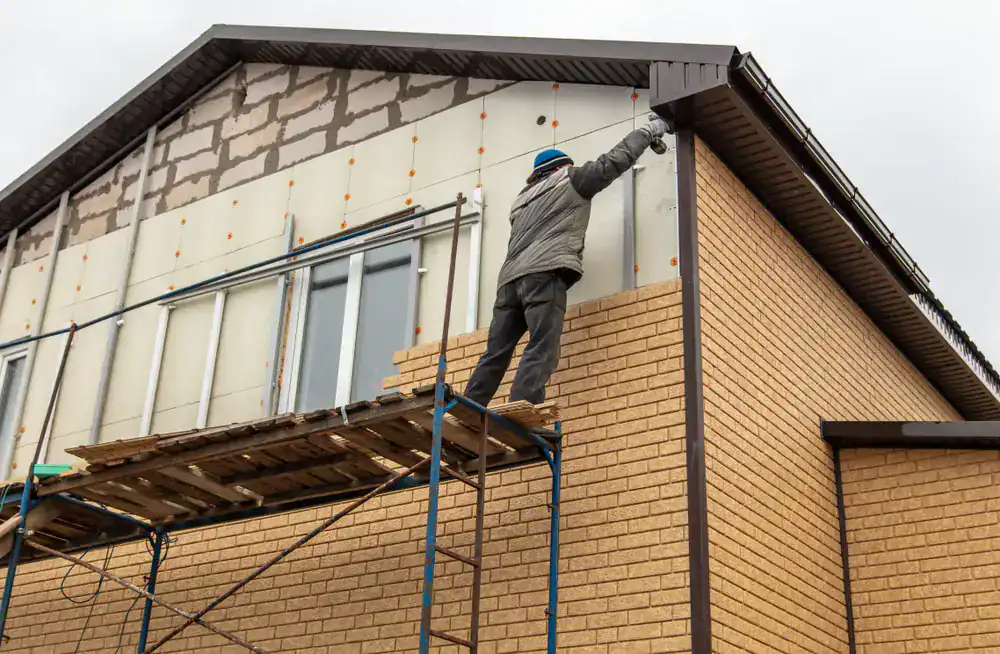
Siding installation with us covers the full scope — removal of existing cladding, substrate inspection, moisture barrier installation, new siding installation, and cleanup when the job is done. Nothing is handed off or subcontracted out to an unfamiliar crew. The same team that starts your project finishes it.
Harrington Park’s mix of Colonials, split-levels, Tudors, Dutch Colonials, and ranches means no two jobs are identical. Older homes built during the borough’s primary growth period often have substrate issues that don’t show up until the original siding comes off — rot, moisture damage, or compromised sheathing that needs to be addressed before new cladding goes on. That substrate inspection step isn’t optional. Skipping it and installing new siding over a damaged surface is how you end up with the same problem in five years instead of twenty-five.
Material options span the full range of what’s available in the current market. Vinyl siding — including insulated profiles that add a meaningful layer of thermal resistance — is the most common choice for its durability and low maintenance in this climate. Fiber cement, particularly James Hardie products, is the right call for homeowners who want the look of wood without the maintenance demands or the vulnerability to moisture that real wood carries in a wet Northeast climate. Engineered wood from LP SmartSide offers a middle path — real wood aesthetics with significantly better resistance to the freeze-thaw cycles Bergen County delivers every winter. Whatever you choose, the installation is backed by manufacturer certifications that unlock enhanced warranty coverage beyond what a standard installation provides.

Do I need a permit to replace siding on my home in Harrington Park?
Yes — siding replacement in Harrington Park requires a building permit under Chapter 131 of the Borough Code, which governs construction and exterior renovation work. You can reach the Harrington Park Building Department directly at 201-768-2585 if you want to confirm specifics before a project starts.
What makes this especially important in Harrington Park right now is the borough’s May 2024 Residential Resale Certificate requirement. If you’re planning to sell your home, the borough requires a certificate of compliance before the transaction closes — and unpermitted exterior work can hold that up or create complications during the buyer’s inspection process. A properly permitted siding installation protects you at sale, not just during the project itself. We handle permit coordination as part of every job in Harrington Park, so this doesn’t become something you’re managing on your own.
How do I know if my siding needs full replacement or just repairs?
The honest answer is that it depends on how much of the siding is affected and what’s happening underneath it. Isolated damage — a few cracked panels, a section that took impact from a branch, some caulking failure around a window — is often repairable without replacing the entire exterior. But when damage is widespread, when panels are warping or buckling across multiple elevations, or when you’re seeing interior moisture signs like water stains or soft drywall near exterior walls, those are indicators that the cladding has failed systemically rather than in isolated spots.
For homes in Harrington Park’s primary growth era — built between roughly 1950 and 1970 — the age of the material is itself a factor. Vinyl siding has a lifespan of 20 to 40 years depending on installation quality and climate exposure. If the siding on your home is original or was last replaced in the 1980s or early 1990s, it’s at or past the end of its expected service life regardless of how it looks from the street. A free inspection from us will give you a straight answer on where your home actually stands — no upsell, no pressure to replace what doesn’t need replacing.
What siding material holds up best in Bergen County's climate?
The freeze-thaw cycle is the most mechanically destructive force acting on exterior cladding in northern Bergen County. Temperatures fluctuate above and below freezing repeatedly throughout late fall and early spring — sometimes multiple times in a single week — and any moisture that’s worked its way into gaps or failed seams expands when it freezes and contracts when it thaws. Over time, that cycle cracks panels, opens seams, and works fasteners loose. So the right material question for Harrington Park isn’t just about aesthetics or price — it’s about what performs in this specific climate.
Insulated vinyl siding handles the thermal cycling well and adds a layer of continuous insulation that standard vinyl doesn’t provide. Fiber cement — James Hardie in particular — is dimensionally stable through temperature swings and highly resistant to moisture intrusion, which makes it one of the strongest performers in a Northeast climate. Engineered wood from LP SmartSide offers real wood character with significantly better resistance to moisture and freeze-thaw stress than traditional wood clapboard. All three are solid choices depending on your home’s style and your priorities. What matters most is that whichever material you choose is installed correctly — with proper moisture barrier, correct fastening tension, and flashed penetrations — because installation quality determines longevity more than the material itself in most cases.
How long does siding installation take for a typical Harrington Park home?
For a standard single-family home in Harrington Park — a Colonial, split-level, or ranch of typical size — full siding replacement generally runs between three and seven days of active installation time, depending on the square footage, the number of stories, and what’s found during substrate inspection once the old siding comes off. Homes with more architectural complexity — dormers, multiple gable ends, detailed trim work around windows — take longer than straightforward elevations.
The timeline also accounts for permitting, which adds lead time before installation begins. Harrington Park’s Building Department processes permits for exterior work, and the timeline for approval can vary depending on current volume. For homeowners on a deadline — particularly those preparing their home for the spring real estate market, which moves fast in Bergen County — booking early matters. Quality siding contractors in this area typically run four to eight weeks out during peak season, which runs April through June and again in September and October. If you’re planning a spring project, getting your estimate and permit process started in late winter gives you the best chance of hitting your target window.
What's the difference between a licensed siding contractor and an unlicensed one in New Jersey?
In New Jersey, all home improvement contractors are required to register with the NJ Division of Consumer Affairs under the Home Improvement Contractor program — commonly called HIC registration. This is a legal requirement, not an optional credential. Hiring an unregistered contractor is a violation of the Consumer Fraud Act, and more practically, it leaves you with no legal recourse if the work is done poorly, the contractor disappears, or a dispute arises over billing or damage.
For a Harrington Park homeowner with a property valued anywhere from $850,000 to well over a million dollars, that’s not a theoretical risk — it’s a real financial exposure on a high-value asset. Beyond the state registration requirement, licensed contractors who also hold manufacturer certifications can offer enhanced product warranties that unlicensed or uncertified installers cannot. Those extended warranties are tied to the installer’s certification status, not just the product itself. So when you hire a certified contractor, you’re not just buying installation — you’re buying warranty coverage that protects your investment for years after the job is finished. Always ask for proof of HIC registration and insurance before any contractor starts work on your home.
Does new siding actually increase home value in a market like Harrington Park?
In most markets, the ROI calculation on new siding is straightforward. In Harrington Park specifically, where median home sale prices range from roughly $850,000 to over a million dollars and homes move in an average of 34 to 41 days when presented well, the curb appeal impact of new siding is amplified. Buyers at this price point are not overlooking a tired or visibly aging exterior — they’re factoring it into their offer or using it as negotiating leverage. A home with fresh, well-installed siding signals that the property has been maintained, which matters to buyers and to the appraisal process.
Remodeling Magazine’s annual Cost vs. Value Report consistently ranks vinyl siding replacement among the top exterior projects for cost recoupment, with returns typically in the 67 to 80 percent range nationally — and in high-value Northeast markets, the actual dollar return tends to be higher simply because the home values are higher. Beyond the sale scenario, new siding reduces ongoing maintenance costs, can lower energy bills if insulated siding is chosen, and eliminates the kind of deferred maintenance that compounds into larger problems over time. For a Harrington Park homeowner planning to stay in their home for another ten to twenty years, the value case is about protection and performance as much as it is about resale.