Hear from Our Customers
Most gutter problems don’t announce themselves until something expensive happens — a wet basement, paint peeling off the siding, soil washing away from the foundation. By then, the gutters have been failing quietly for months, sometimes years. The right installation stops that cycle before it starts.
For homes on Mountainside’s hillside lots along the Watchung Ridge, that matters more than it does on flat ground. Water moves faster on a slope. When gutters overflow or downspouts drain too close to the house, the water doesn’t just sit there — it concentrates and pushes directly toward your foundation. Proper slope calculation, correct gutter sizing, and downspout placement that routes water well away from the structure are what separate a gutter job that protects your home from one that just looks like it does.
The other reality in Mountainside is the tree canopy. The Watchung Reservation borders the northwestern edge of the borough, and the oaks, maples, and hickories lining the residential streets shed heavily every fall. Gutters installed without the right pitch and bracket system will sag, hold debris, and back up under that kind of seasonal load. A properly installed system drains completely between cleanings and holds its shape through the weight of a full autumn’s worth of leaves — and through the freeze-thaw cycles that follow every winter.
We’re based in Elizabeth, NJ — Union County, same as Mountainside. Over the past ten-plus years, we’ve worked on homes throughout this county, and the Mountainside jobs are not generic — they’re hillside colonials and split-levels with mature tree coverage, aging fascia boards, and drainage grades that require more thought than a standard flat-lot install.
We hold NJ Home Improvement Contractor License #13VH10605800, which is the credential Mountainside’s own Construction Department requires contractors to carry before filing for any permit in the borough. Beyond the state license, we hold manufacturer certifications that qualify installations for manufacturer-backed warranty coverage — not just our word that the job was done right.
When you call for a gutter inspection or estimate, you’re not getting a sales pitch. You get an honest look at what’s there, what’s failing, and what actually needs to be done. Free estimate, no obligation, no hidden charges after the fact.
It starts with a free inspection. Before anything is quoted or scheduled, someone from our team comes out to your Mountainside home and looks at the full picture — not just the gutters, but the fascia boards behind them, the roof edge above them, and the grade of the ground below the downspouts. On a sloped lot, that last part matters as much as anything else. If the downspout is draining six inches from your foundation on a hillside, that’s a problem the gutter replacement itself won’t fix unless it’s addressed during the install.
Once the inspection is done, you get a written estimate with a clear scope of work. No vague line items, no verbal agreements that change when the invoice arrives. If your fascia boards are rotted and need to be replaced before new gutters can be mounted, that gets noted upfront — because new gutters on compromised backing will fail within a few years regardless of the quality of the gutters themselves.
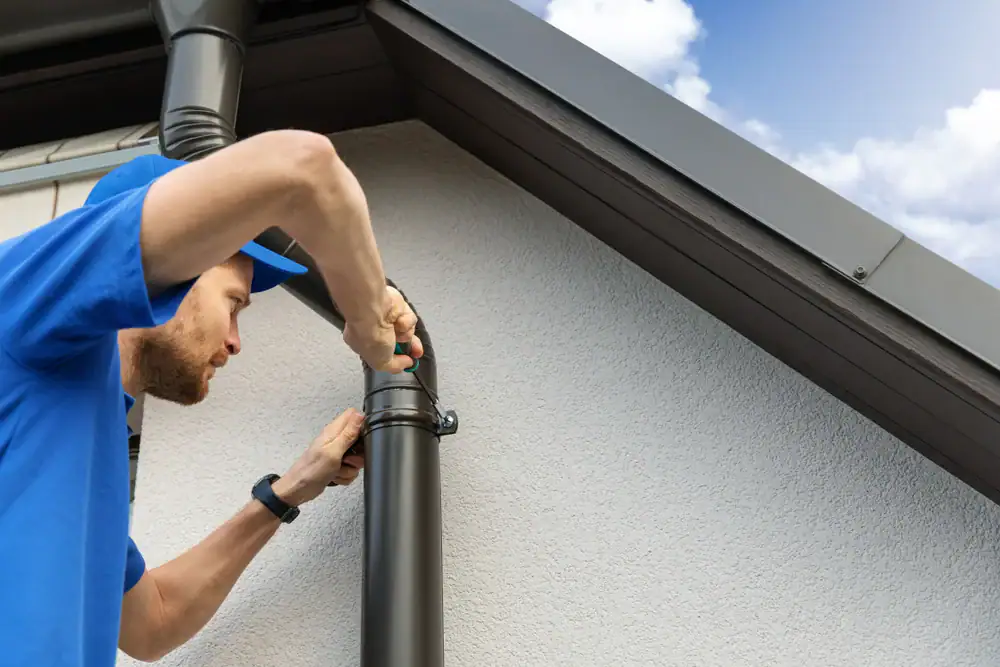
Installation day is straightforward. Gutters are custom-fabricated on-site as seamless runs cut to your roofline’s exact measurements — no pre-cut sections, no seams along the run where leaks typically start. Brackets are set at the correct pitch for your specific run length, downspouts are sized for your roof’s actual drainage load, and extensions are positioned to direct water away from the foundation. Cleanup is part of the job. When the crew leaves, the work is done.
Ready to get started?
We install seamless aluminum gutters custom-fabricated on-site for each home. The seamless design eliminates the joints that sectional systems rely on — and where most leaks originate. For Mountainside homes with complex rooflines, dormers, or multiple drainage planes, seamless fabrication means every run fits precisely rather than being forced to approximate with pre-cut sections.
Every installation includes a full assessment of the fascia and soffit before brackets are mounted. Given that the median Mountainside home was built around 1958, it’s not uncommon to find fascia boards that have been holding gutters for decades and are no longer structurally sound enough to support a new system. If that’s the case, it gets addressed before installation, not discovered after. Downspout sizing is calculated based on actual roof square footage and pitch — not a one-size-fits-all approach — and extensions are set to route water a safe distance from the foundation, which is especially critical on the sloped lots throughout the borough.
If your gutters were damaged by a storm — a falling branch from the Watchung Reservation canopy, wind-driven debris, or ice damage from a bad winter — we also assist with homeowner’s insurance claims. That includes documentation and adjuster communication, so you’re not navigating the claims process alone while also managing a damaged home. If your coverage applies, we help you use it.
The honest answer is that it depends on what’s failing and why. If you’re dealing with isolated leaks at a seam or a single section that’s pulled away from the fascia, repair is often the right call — there’s no reason to replace a system that’s otherwise sound. But if you’re seeing consistent overflow during heavy rain, multiple sections sagging or separating, gutters that are visibly pulling away from the roofline in several spots, or water staining on the siding in a pattern that suggests chronic overflow, those are signs the system as a whole has reached the end of its useful life.
For most Mountainside homes built in the late 1950s or 1960s, the math is worth thinking about. Aluminum gutters typically last 20 to 30 years. A home built in 1958 that’s had one gutter replacement since original construction may be running on a system that’s 25 to 35 years old. At that age, even gutters that look passable from the ground are often corroded at the seams, sagging between brackets, and no longer pitched correctly. A free inspection gives you a clear answer without any obligation to move forward.
Standard residential gutters are typically 5 inches wide, but that sizing is based on average roof pitch and average rainfall — neither of which fully describes a Mountainside property bordering the Watchung Reservation. Homes with steeper roof pitches shed water faster than the standard calculation assumes, which means 5-inch gutters can be undersized even on a moderately sized roof. Add the leaf load from the oaks, maples, and hickories along the borough’s western streets, and you have a system that’s working harder than it was designed to.
For homes with significant roof area, steep pitch, or heavy canopy coverage, 6-inch gutters are often the better choice. They handle higher water volume and are less prone to overflow during the kind of intense rainfall events Union County sees — including the flash flood in July 2025 that dropped over 5 inches on Mountainside in a single storm. Downspout sizing matters just as much: a 6-inch gutter paired with an undersized downspout creates a bottleneck that negates the benefit of the wider gutter. The right answer comes from measuring your actual roof, not applying a default.
Yes — and it’s one of the more common connections that homeowners don’t make until after the fact. When gutters overflow, the water doesn’t just fall off the edge of the roof harmlessly. It saturates the soil directly adjacent to the foundation. On a flat lot, that’s a problem. On a sloped Mountainside lot, it’s worse, because the grade can direct that saturated water toward the foundation wall rather than away from it.
Over time, repeated overflow in the same spot erodes the soil, creates hydrostatic pressure against the foundation wall, and eventually finds a path inside — through cracks, through the joint between the footing and the wall, or through window wells that weren’t designed to handle that kind of water volume. Foundation waterproofing repairs typically run $5,000 to $30,000 depending on severity. A full gutter replacement on most Mountainside homes costs a fraction of that. Prevention is far more cost-effective than remediation.
It can, depending on the cause of the damage and your specific policy. Most standard homeowner’s insurance policies in New Jersey cover sudden, accidental damage caused by a covered peril — wind, hail, falling branches, or storm-driven debris. If a branch from the Watchung Reservation canopy came down on your gutters during a storm, or if a severe wind event bent or tore sections away from the fascia, that’s typically the kind of damage that qualifies for a claim.
What’s generally not covered is damage from gradual deterioration — gutters that failed over time due to age, rust, or lack of maintenance. The distinction matters because insurance adjusters are trained to identify the difference, and claims based on wear and tear are routinely denied. If you’ve experienced storm damage and aren’t sure whether it qualifies, we can inspect the damage, document it properly, and work directly with your adjuster. Union County has been hit by multiple significant storm events in recent years, and having a contractor who understands the claims process on your side makes a real difference in the outcome.
Sectional gutters are pre-cut in standard lengths — typically 10 to 20 feet — and joined together on-site with connectors and sealant. Every joint is a potential leak point, and over time, the sealant breaks down, the sections shift, and water finds its way through. For a home in Mountainside that sees 48 inches of annual precipitation plus intense storm events, that’s a lot of stress on a lot of seams.
Seamless gutters are custom-fabricated on-site in a single continuous run from one end of the roofline to the downspout — no joints along the run, no sealant that degrades, no connectors that shift. The only seams are at the corners and downspout connections, which are unavoidable and properly sealed. The result is a system that handles water volume better, lasts longer, and requires less maintenance over time. For a home worth $800,000 or more on a wooded hillside lot, the difference in cost between sectional and seamless is minor relative to the difference in performance and longevity. Most homeowners who’ve had both don’t go back.
For most Mountainside homes, a full gutter replacement takes one day. The timeline depends on the size of the home, the complexity of the roofline, and whether any fascia or soffit work needs to happen before installation can begin. A straightforward replacement on a colonial or ranch-style home typically runs four to eight hours from setup to cleanup. Homes with multiple stories, dormers, or extensive linear footage may run longer, but that gets communicated clearly during the estimate — not discovered on installation day.
You don’t need to be home for the installation itself, but it’s helpful to be available for the initial inspection so you can walk the property and ask questions directly. That’s the conversation where you’ll hear what was found, what’s being recommended, and why — and it’s a better use of your time than trying to interpret it after the fact from a written report. If you’re commuting into the city and can’t be there during the day, the inspection can be scheduled around your availability. The goal is to make sure you understand what’s being done to your home before any work begins.
Other Services we provide in Mountainside