
Siding Installation in Elizabeth, NJ
Elizabeth Homes Deserve More Than a Quick Fix
Hear from Our Customers
Vinyl Siding Contractors in Elizabeth, NJ
When siding fails in Elizabeth, it rarely fails quietly. You start noticing it in your energy bills first — drafts that weren’t there before, rooms that take longer to heat in January. Then comes the visible stuff: panels warping near the foundation, fading that’s uneven, or soft spots around windows where moisture has already started working its way in. By the time most homeowners call, the problem has been building for a while.
Good siding installation doesn’t just fix what you can see. It addresses the full moisture management system — housewrap, flashing, proper overlap — so water has nowhere to go except away from your home. For homes near the waterfront sections of Frog Hollow or Bayway, where salt air and storm surge risk are real factors, that level of installation isn’t optional. It’s what separates a job that lasts twenty-five years from one that starts showing problems in five.
Elizabeth’s housing stock in neighborhoods like the North End and Peterstown is predominantly 1920s to 1940s construction. That age means the sheathing underneath your current siding may need attention before new panels go on. A thorough installation accounts for that — it doesn’t just cover the problem, it resolves it.
Residential Siding Contractors in Elizabeth, NJ
We’ve been working on homes across Elizabeth and Union County for close to ten years. That’s not a marketing number — it’s the kind of track record that only comes from doing the work right, consistently, and earning the next job through the last one. We started with roofing and expanded into siding and gutters because exterior systems don’t work in isolation. A contractor who understands how a roof handles water understands how siding needs to be installed to work with it.
We’re fully licensed under New Jersey’s Home Improvement Contractor registration program and carry the manufacturer certifications that unlock full warranty coverage on the materials we install. That matters in a city like Elizabeth, where the Bureau of Construction enforces the NJ Uniform Construction Code and unpermitted work can create real problems at resale.
Every estimate we write is detailed and honored. No surprise additions mid-project. No pressure to approve work that wasn’t discussed. That’s not a policy — it’s just how a company that depends on local word-of-mouth stays in business for ten years.

Siding Installation Process in Elizabeth, NJ
It starts with a free inspection. One of our crew members comes out, looks at what you’re working with, and gives you an honest read on what the siding actually needs — repair, partial replacement, or full installation. If your Elizabeth home is in one of the older neighborhoods, that inspection will also check the substrate underneath. Homes built in the 1920s and 1930s sometimes have sheathing issues that need to be addressed before new siding goes on, and you deserve to know that upfront rather than after demo day.
From there, you get a written estimate that breaks down materials, removal of existing siding, moisture barrier installation, trim work, and cleanup. If a permit is required under Elizabeth’s Bureau of Construction — which applies to certain scopes of work under the NJ Uniform Construction Code — we handle that process as part of the job. You won’t be left figuring out the paperwork on your own.
Installation timing in Elizabeth tends to run best in spring and early fall, when temperatures are stable enough for vinyl to be set with proper expansion gaps. That detail matters more than most homeowners realize — panels installed too tight in cold weather can buckle by summer. We account for seasonal conditions on every job, not just the ones where it’s obvious.

Ready to get started?
Local Siding Company Serving Elizabeth, NJ
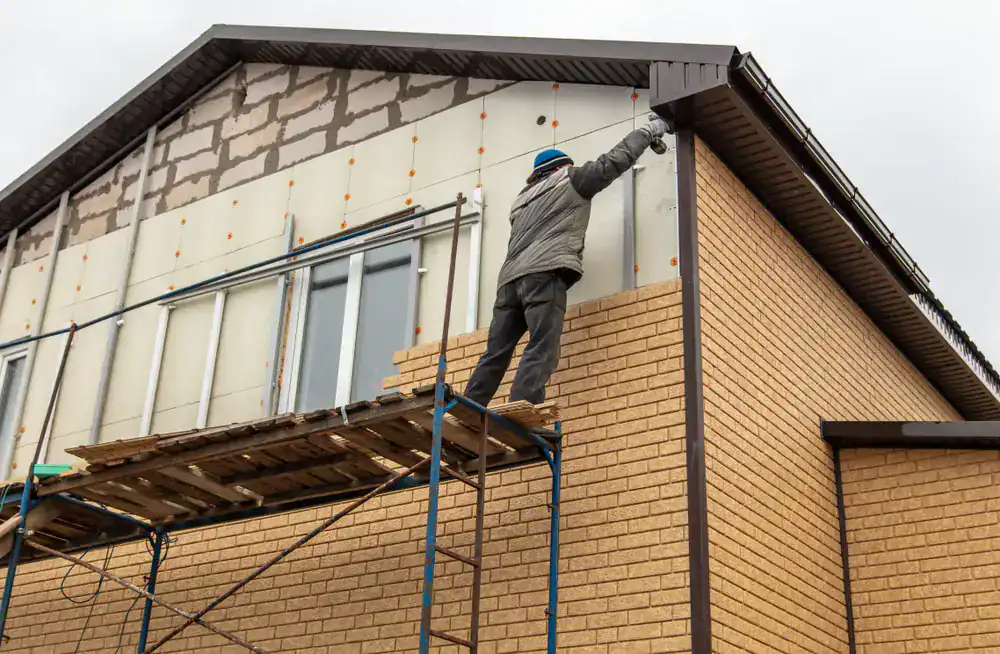
Siding installation with us covers the full scope — not just the panels. That means removal and disposal of your existing siding, installation of the moisture barrier and housewrap, proper flashing at every window, door, and penetration, and all trim work finished cleanly before we leave. For Elizabeth homeowners managing two- or three-family properties, which make up a significant share of the city’s housing stock, we have the experience to handle larger surface areas, coordinate around active tenants, and work cleanly in the tight lot conditions that are common throughout the city.
Material options include vinyl, fiber cement, and James Hardie products, selected based on your home’s exposure, your budget, and the architectural character of the property. Homes in Westminster or Elmora with older Colonial and Victorian profiles may need a different approach than a post-war two-family in the North End — and that’s a conversation that happens during the estimate, not after the job starts.
Every installation is backed by manufacturer warranty coverage, which is only accessible when the work is done by a certified installer meeting the manufacturer’s specifications. That warranty is real protection, especially in a city where 16 of 57 census tracts carry significant flood and storm surge risk. When the next nor’easter comes through, you want to know your siding was installed to hold.

Do I need a permit for siding replacement in Elizabeth, NJ?
In many cases, yes. Elizabeth’s Bureau of Construction oversees all home improvement work under the New Jersey Uniform Construction Code, and siding replacement that involves changes to the building envelope — including removal of existing cladding and installation of new moisture barriers — typically requires a building permit. The exact threshold depends on the scope of the project, but it’s not something to guess on. Unpermitted work can surface as a serious problem when you go to sell the property, and it can also affect how your homeowner’s insurance handles a future claim.
When we handle a siding installation in Elizabeth, the permitting question gets answered during the estimate phase, not after demo has already started. If a permit is required, we manage that process as part of the project. You shouldn’t have to navigate the city’s Bureau of Construction on your own — that’s part of hiring a contractor who actually knows how to work in Elizabeth.
How do I know if my siding needs repair or full replacement?
The honest answer is that it depends on what’s happening underneath the panels, not just what you can see from the street. Cracked or faded panels on their own might be a repair situation. But if there’s moisture intrusion behind the siding — which is common in Elizabeth homes near the waterfront areas of Frog Hollow and Bayway, or in older properties where the original moisture barrier has degraded — patching the surface doesn’t fix the underlying problem. You end up spending money twice.
Our free inspection is specifically designed to answer this question without any obligation on your part. We’ll assess the visible condition, check for soft spots or moisture damage around windows and at the foundation line, and give you a straight answer on whether repair makes sense or whether replacement is the more cost-effective path. In homes built in the 1920s and 1930s — which describes a large portion of Elizabeth’s North End and Peterstown housing stock — full replacement often reveals substrate issues that would have continued causing damage regardless of what was done on the surface.
How long does vinyl siding typically last on an Elizabeth, NJ home?
Under normal conditions, quality vinyl siding has a lifespan of roughly 20 to 40 years. But Elizabeth’s environment pushes that range toward the lower end for homes with certain exposures. The combination of humid summers, freeze-thaw cycling in winter, and proximity to Newark Bay and the Arthur Kill means siding in coastal-adjacent neighborhoods faces more stress than siding on an inland suburban home. Salt air, wind-driven rain from nor’easters, and the atmospheric conditions near the port and airport all contribute to accelerated surface wear — particularly fading, chalking, and panel brittleness.
Proper installation extends that lifespan significantly. Panels that are set with the correct expansion gaps for New Jersey’s temperature range, backed by a quality housewrap, and flashed correctly at every penetration will outlast a faster, cheaper installation by years. The difference usually isn’t visible on day one — it shows up in year eight or twelve when one job is still holding and the other is starting to fail.
What siding material works best for older homes in Elizabeth, NJ?
For most Elizabeth homeowners, vinyl remains the most practical choice — it’s durable, low-maintenance, and handles the city’s climate well when installed correctly. But for homes with more architectural character, particularly in neighborhoods like Westminster or Elmora where Victorian and Colonial profiles are common, fiber cement or James Hardie products offer a look that holds up better against the original character of the home. Hardie in particular holds paint significantly longer than wood and resists moisture and impact better than vinyl in high-exposure situations.
The right answer depends on your home’s specific profile, its exposure conditions, and your budget. A two-family in the North End has different needs than a single-family on a tree-lined block near Warinanco Park. That’s a conversation worth having during the estimate — not a decision that should be made based on whatever material the contractor happens to have in stock. We work with multiple material options and will walk you through what makes sense for your specific property.
How do I verify a siding contractor is licensed to work in Elizabeth, NJ?
New Jersey requires all home improvement contractors performing work over $500 to be registered under the Home Improvement Contractor program, administered by the NJ Division of Consumer Affairs. This isn’t optional — it’s state law, and it’s enforced. Hiring an unregistered contractor in Elizabeth leaves you without legal recourse under the Consumer Fraud Act if the work is defective or the contractor walks off the job. Given Elizabeth’s large population of first-generation homeowners who may not be familiar with these requirements, it’s a protection worth understanding clearly.
Verifying registration is straightforward. Ask any contractor you’re considering for their HIC registration number before signing anything. You can confirm it directly through the NJ Division of Consumer Affairs’ public database. A legitimate contractor will provide that number without hesitation. We’re fully registered and licensed, and proof is available on request. Beyond HIC registration, ask about general liability insurance and workers’ compensation — both should be current, and both protect you if something goes wrong on your property during the job.
What should I expect to pay for siding installation in Elizabeth, NJ?
For a typical single-family home in Elizabeth, vinyl siding installation generally runs between $8,000 and $15,000 depending on the size of the home, the condition of the substrate, and the material selected. Fiber cement and James Hardie products run higher — typically $12,000 to $20,000 or more for a full replacement — because the materials cost more and the installation is more labor-intensive. For two- and three-family homes, which are common throughout Elizabeth’s residential neighborhoods, the total scope is larger and pricing reflects that accordingly.
What matters as much as the number is what’s included in it. A written estimate from us covers removal and disposal of existing siding, moisture barrier and housewrap, all flashing, trim work, and cleanup — not just the panels themselves. That’s the full scope of a proper installation. If a contractor quotes you a number that seems significantly lower than others, it’s worth asking exactly what’s included, because the difference is almost always in what gets left out. Transparent, written pricing is standard here — the number on the estimate is the number on the invoice.