
7 Warning Signs Your Home Needs a Siding Inspection
Summary:
Most Elizabeth homeowners don’t think about their siding until something is obviously wrong. That’s understandable — it’s not the kind of thing you check on a Saturday morning. But siding doesn’t fail all at once. It fails gradually, in ways that are easy to miss until the damage has already spread behind the panels, into the wall cavity, and sometimes into the interior of your home.
These seven signs are the ones we see most often when homeowners in Elizabeth finally call us. Some are urgent. Some just need monitoring. All of them are worth knowing.
What Does Damaged Siding Actually Look Like From the Outside?
The honest answer is: not much, at first. That’s what makes siding damage so easy to underestimate. A panel that looks slightly off from the driveway might be hiding a moisture problem that’s been building for two or three winters.
Elizabeth’s climate doesn’t do your siding any favors. Freeze-thaw cycles, nor’easters, summer humidity, and the occasional hail event all stress the exterior of your home in different ways. With more than 40% of Elizabeth’s housing stock built before 1950, a lot of homes in this city are on siding that is well past its expected service life, whether the owner knows it or not.
The seven signs below are things you can check yourself. They’re observable, specific, and each one tells a different story about what’s happening behind the surface.
Signs 1–4: What You Can See From the Ground
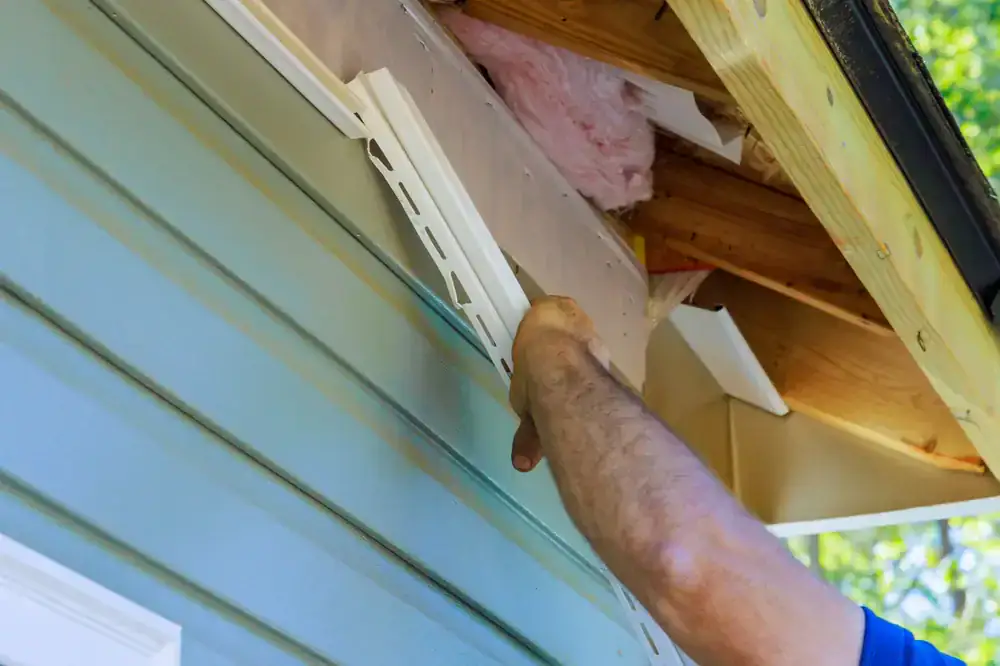
The first sign to look for is gaps at the seams. Siding panels are designed to interlock and overlap in a way that keeps water out even during heavy rain. When those seams open up — whether from age, impact, or improper installation — water gets in. Not a little water. Water that sits behind the panel, against the house wrap or sheathing, and starts working on whatever is underneath.
In Elizabeth, where roughly 32% of buildings carry documented flood risk, moisture intrusion is not a hypothetical concern. If you can see daylight between panels, or if a seam that used to sit flush now has a visible gap, that’s not cosmetic. Get it looked at.
The second sign is green streaks or mildew growth on the surface of your siding. A lot of homeowners assume this is just dirt and reach for the pressure washer. Sometimes that’s right. But green streaks — especially when they keep coming back in the same spots — often mean moisture is being trapped at or behind the surface.
High-pressure washing can actually push water into seams and behind the laps, making the underlying problem worse. If you’re seeing recurring growth, the more useful question is why that area stays wet long enough for mildew to form.
Third: loose panels, especially after a storm. A single loose panel after a nor’easter might just mean a fastener worked free. But if you’re finding multiple panels that have shifted, lifted, or separated after wind events, that’s a pattern.
It means the attachment system is compromised — and every gap is an entry point for water and cold air. After any significant storm, it’s worth walking the perimeter of your home and looking for panels that sit differently than they did before.
Fourth is hail dents. Hail damage to siding is easy to miss because the dents are often small and scattered. On vinyl, you may see cracks or splits rather than visible dents. On aluminum, the dents are more obvious. Either way, impact damage creates weak points in the panel surface that allow water to penetrate over time.
If your area got hit with hail and you haven’t had your siding checked since, that’s worth adding to your list — especially because documented hail damage is often covered by homeowner’s insurance, and we can help you through that process.
Signs 5–7: The Ones Most Homeowners Miss Until It's Too Late
The fifth sign is warped or buckling siding. When vinyl siding buckles or ripples along the face of a panel, it usually means one of two things: either it was installed without enough room to expand and contract with temperature changes, or it’s been exposed to heat or moisture long enough to deform.
Either way, a panel that’s no longer lying flat against the wall is no longer doing its job. It’s creating gaps, directing water in directions it shouldn’t go, and telling you that something in the wall assembly isn’t right. This is one of the signs that tends to get dismissed as cosmetic, but it rarely is.
The sixth sign is fading that goes beyond normal weathering. All siding fades over time — that’s expected. But when the color fades unevenly, or when sections of siding look chalky or washed out while others look normal, it can indicate that the material is degrading faster in certain areas, often because of prolonged moisture exposure or UV damage that has compromised the surface layer.
Heavily faded siding also loses some of its ability to reflect heat, which connects directly to the seventh sign.
That seventh sign is rising energy bills — and it’s the one most homeowners never connect to their siding. When siding fails, it doesn’t just let water in. It lets air in too. Gaps, cracks, and delaminated panels all compromise the wall’s insulation performance, which means your heating system works harder in January and your cooling system works harder in July.
Elizabeth homeowners already deal with a cost of living that runs above the national average. If your bills have been creeping up and you haven’t changed anything about how you use energy, your exterior might be the reason. It’s worth ruling out before you replace your HVAC.
Want live answers?
Connect with a USA Home Remodeling LLC expert for fast, friendly support.
What Happens During a Siding Inspection — and What We're Actually Looking For
A professional siding inspection isn’t just a visual scan from the driveway. It covers the full exterior envelope: the panels themselves, the trim, the flashing around windows and doors, the caulking at seams and penetrations, and anywhere water might be finding a path behind the surface.
Where accessible, we also check for soft spots and signs of moisture damage that don’t show up on the face of the siding at all. At the end of the inspection, you get a straight answer. Not a sales pitch — a genuine assessment of whether what we found requires repair, warrants replacement, or just needs monitoring. If repair is the right call, we’ll tell you that.
How Do I Know If I Need Siding Repair or Full Replacement?
This is the question we get most often, and the honest answer is that it depends on what we find — not on a formula. If the damage is isolated to one section of the home, the underlying sheathing is dry and structurally sound, and the siding itself is relatively young, repair almost always makes more sense than replacement.
Replacing perfectly functional siding just because one area has a problem is wasteful and unnecessary, and we’ll tell you that directly.
On the other hand, if the siding is 30 or 40 years old, if we’re finding moisture damage in multiple areas, or if the original installation had problems that are now showing up everywhere at once, replacement starts to make more sense — not because it’s a bigger job, but because patching aging material that’s failing across the board tends to be a short-term fix that costs more over time.
Elizabeth’s housing stock makes this question especially relevant. The median home in Elizabeth was built in 1957. A home that’s never had its siding replaced is likely running on material that is well past the 20-to-40-year service life that vinyl siding typically carries. That doesn’t automatically mean replacement — but it does mean the inspection matters more, not less. Knowing the actual condition of what’s there is far more useful than guessing.
One thing worth knowing: if your siding damage came from a storm — hail, wind, a fallen branch — it may be covered under your homeowner’s insurance policy. We help document that kind of damage and work directly with insurance companies throughout the process. A lot of homeowners don’t realize that’s an option, and it can change the financial picture significantly.
Common Questions Elizabeth, NJ Homeowners Ask Before Scheduling a Siding Inspection
One of the most common questions we hear is: “How often should I get a siding inspection?” The general recommendation from industry professionals is at least once a year, or after any significant storm. For Elizabeth homeowners specifically, fall and spring are the most useful times — fall to catch anything before freeze-thaw cycles make it worse, and spring to assess whatever the winter left behind.
If you’ve had a storm event and you’re not sure whether your siding took any damage, that’s always a good reason to schedule a look regardless of where you are in the calendar.
Another question we hear often: “Can I just pressure wash the green stuff off and call it done?” Sometimes, yes — surface algae on siding that’s otherwise in good condition can be cleaned without any further intervention. But if the growth is coming back repeatedly in the same spots, or if you’re also seeing any of the other signs on this list, cleaning the surface doesn’t address what’s underneath.
It’s worth having someone check whether moisture is being retained behind or within the panel before you write it off as cosmetic.
A third question: “Is there anything I should check on the inside of my home?” Absolutely. Interior symptoms are often the clearest early signal that siding is failing. Peeling paint or wallpaper on an exterior wall, water stains that appear after heavy rain, drafts near windows and outlets on outside walls, and mold or mildew growth inside closets that back up to exterior walls — all of these can indicate that water is getting through the siding and into the wall cavity.
By the time you’re seeing interior symptoms, the problem has usually been developing for a while. That doesn’t mean it’s catastrophic, but it does mean it’s past the “wait and see” stage.
Finally: “How much does a siding inspection cost?” Ours is free. No charge, no obligation. You get an honest assessment of what we found and a clear recommendation on what, if anything, needs to happen next. If you decide you want to move forward with repair or replacement, we’ll give you a detailed estimate. If you decide to wait or get a second opinion, that’s your call. The inspection itself costs you nothing.
When to Stop Watching and Start Getting Answers
Siding problems don’t fix themselves, and they don’t stay the same size. Water that gets behind a panel in October tends to find more to damage by March. The seven signs in this post — gaps at seams, mildew and green streaks, loose panels, hail dents, warping, fading, and rising energy bills — are the ones that show up most often in homes that needed attention sooner than they got it.
If you recognized one or more of these on your own home, the next step doesn’t have to be complicated. USA Home Remodeling has been serving Elizabeth and the surrounding Union County area for 17 years. We’re licensed, fully insured, and locally based — not a regional chain, not a storm-chaser.
If your home needs a siding inspection near me — or if you’re simply ready to get answers about what’s happening behind your panels — we’ll come out, take a real look, and give you a straight answer. That’s the whole offer.