
Gutter Repair & Roof Leak Integration Solutions
Summary:
You’ve got a water stain spreading across your ceiling. Maybe you’ve already climbed into the attic and spotted moisture. The question isn’t whether you have a leak—it’s where that water is actually getting in. Roof? Gutters? Both? The answer determines whether you’re looking at a $300 repair or a $3,000 problem that keeps coming back. This isn’t about choosing between gutter repair and roof work. It’s about understanding how your home’s water management works as a system, recognizing when one failure triggers another, and knowing what solutions actually last. Let’s start with how gutters and roofs fail together.
How Gutter Repair Prevents Roof Leaks
Your gutters exist to move water away from your roof edge and foundation. When they can’t do that job, the water doesn’t just disappear. It goes somewhere, and that somewhere is usually under your shingles, behind your fascia, or into your attic. Clogged gutters are one of the most underrated causes of roof leaks, especially along the eaves where shingles meet the roof edge.
When leaves, twigs, and debris fill your gutters, rainwater has nowhere to go but over the sides or backward—up and under your roof shingles. That backup creates what looks like a roof leak, but the entry point isn’t a damaged shingle or failed flashing. It’s water being forced where it shouldn’t be because your gutter system failed first. Union County gets hit with summer storms that dump inches of rain in minutes and nor’easters that overwhelm even well-maintained systems.
Gutter repair isn’t just about fixing sagging sections or sealing leaking corners. It’s about restoring proper water flow so your roof doesn’t have to handle water it was never designed to manage. When gutters work correctly, water moves off your roof and away from your home. When they don’t, you’re asking your roof to do a job it can’t handle, and leaks follow.
Why Clogged Gutters Cause More Damage Than You Think
Clogged gutters don’t just cause leaks at the roofline. They create a cascade of problems that extend from your roof to your foundation. When water can’t move through your gutters to the downspouts, it pools, overflows, and finds the path of least resistance—which is rarely the path you want it to take.
Water backing up from clogged gutters seeps under shingles, soaks into fascia boards, and drips behind siding. In winter, that trapped water freezes, expands, and creates ice dams that force melting snow under your roofing materials. The fascia boards that hold your gutters in place start to rot when they’re constantly wet. Once wood rot sets in, you’re not just looking at gutter repair—you’re replacing structural components.
The overflow doesn’t stop at your roofline either. Water pouring over clogged gutters lands right next to your foundation, saturating the soil and creating hydrostatic pressure against basement walls. Over time, that pressure causes cracks, bowing, and water infiltration that can cost tens of thousands to repair. A $200 gutter cleaning prevents all of this.
Union County’s weather makes clogged gutters especially dangerous. Summer humidity makes gutters expand and contract, loosening joints. Fall leaves from mature tree canopies fill systems in days. Winter ice finds every weak spot and makes it worse. Spring storms test whether your gutters can handle high-volume water flow. If they fail any of these tests, your roof and foundation pay the price.
The damage escalates exponentially. One hour of water intrusion saturates drywall. Twenty-four hours starts mold growth. Forty-eight hours compromises structural framing. A homeowner who ignores a “small drip” for three days can face a collapsed ceiling, saturated insulation, mold throughout HVAC ductwork, and $67,000 in combined damage. That’s not a worst-case scenario—it’s a documented case from a recent storm.
Gutter repair and regular cleaning aren’t optional maintenance. They’re the first line of defense for your entire home’s water management system. When gutters fail, everything downstream fails with them.
Small Roof Leak Repair Cost vs. Ignoring the Problem
A small roof leak repair typically costs between $150 and $1,000 in 2026. That range covers everything from resealing a pipe boot to replacing a few damaged shingles or fixing minor flashing issues. The cost depends on the leak’s location, the materials needed, and how quickly you catch it. A leak caught early—before water saturates insulation or damages interior finishes—stays in that affordable range.
The math changes dramatically when you wait. A leak that starts at $300 to fix can become $3,000 in repairs within weeks if water reaches your attic insulation, ceiling drywall, or electrical systems. Mold begins growing in 24 to 48 hours once moisture is present. Water-damaged insulation can’t be dried—it has to be removed and replaced. Ceiling drywall that stays wet cracks and falls apart, leaving holes that require professional repair.
Structural damage is where costs spiral out of control. Water that reaches roof decking, rafters, or trusses compromises the integrity of your roof’s support system. Replacing roof decking costs $2 to $5 per square foot. Roof truss repair runs $300 to $1,700 and typically requires an engineer to confirm structural integrity. If water makes it into wall cavities, you’re looking at mold remediation, drywall replacement, and potential electrical work.
Here’s what homeowners in Union County actually pay for common small leak repairs: pipe boot replacement runs $150 to $400, roof vent resealing costs $100 to $500, missing shingle replacement is $200 to $500, and flashing repair ranges from $300 to $800. These are straightforward fixes when caught early. Wait until water stains appear on your ceiling, and you’re adding interior repairs to the bill—ceiling replacement, paint, possibly flooring if water drips through.
The cheapest roof leak repair is the one you never need, which is why annual roof inspections cost $150 to $400 and catch problems before they become leaks. Inspectors check flashings, boots, valleys, shingles, ventilation, and attic spaces for signs of moisture intrusion. They find the failing pipe boot before it leaks, the lifted flashing before it lets water in, the clogged gutter before it backs water under your shingles.
Temporary fixes have their place in emergencies, but they’re not cost-effective long-term solutions. A properly installed tarp costs $150 to $300 in materials for DIY or $300 to $800 if a roofer does it, and it buys you 30 to 90 days. Roofing cement costs under $20 but only works for very small cracks and is purely temporary. These solutions keep water out while you schedule permanent repairs—they don’t replace them.
The decision point is simple: if your repair estimate exceeds 30% of a full roof replacement cost, most contractors recommend replacing the roof. You get new materials, better energy efficiency, manufacturer warranties, and zero leak risk for 25 to 50 years. For a roof that’s already near the end of its lifespan, that math makes sense. For a newer roof with an isolated leak, a small repair is the smart move.
Want live answers?
Connect with a USA Home Remodeling LLC expert for fast, friendly support.
Finding a Leak When Water Appears Far from the Source
The hardest part of fixing a roof leak is finding where water actually enters. You might see a stain on your bedroom ceiling, but the leak could be several feet away—or even on the other side of the house. Water doesn’t flow straight down once it penetrates your roof. It follows rafters, travels along insulation, pools on attic floors, and eventually escapes through the easiest exit point, which might be a soffit vent, light fixture, or ceiling seam.
This is why “the leak is right above the stain” is almost never true. Water takes the path of least resistance, and that path winds through your attic space before becoming visible inside your home. A leak near your chimney might show up as a stain near an interior wall. A failed valley flashing might cause drips in a room 10 feet away. Finding the actual entry point requires detective work, starting in your attic and working backward from the visible damage.
The most common leak sources aren’t in open shingle areas—they’re at penetrations and transitions. Plumbing vents, HVAC vents, skylights, and chimneys all create holes in your roof that require proper flashing to keep water out. When that flashing fails, cracks, or separates from the roof surface, water gets in. Valleys where two roof sections meet are prone to leaks if the flashing is improperly installed or damaged. The roof edge where gutters attach is vulnerable when gutters overflow and force water backward under shingles.

How to Actually Find Where Your Roof Is Leaking
Start in your attic during daylight hours with a flashlight. Look for water stains on the underside of the roof decking, wet or compressed insulation, mold growth, or actual daylight coming through cracks. Follow any water trails upward—remember, the leak is always higher than where water appears. Pay close attention to areas around roof penetrations like vent pipes, chimneys, and where different roof planes meet.
If you can’t access your attic or don’t find obvious signs, you’ll need to inspect the roof itself. From the ground, use binoculars to look for missing, cracked, or curled shingles, damaged flashing around chimneys and vents, or gaps in roof valleys. If it’s safe to get on the roof and you’re comfortable doing so, look for exposed nail heads, lifted shingles, separated flashing, or areas where sealant has dried and cracked.
When visual inspection doesn’t reveal the source, a water test can pinpoint the entry point. This requires two people: one inside watching for drips, one outside with a garden hose. Start at the lowest point of the roof and work upward in small sections, soaking each area for several minutes before moving higher. The person inside watches for moisture to appear and marks the location. This methodical approach isolates the leak without guessing.
Professional roofers use additional tools when leaks are hard to find. Infrared cameras detect temperature differences caused by moisture trapped in insulation or decking. Moisture meters measure water content in materials without tearing anything apart. These tools reveal hidden damage that’s not visible to the eye, especially important when water has been traveling through your roof system for weeks or months.
The relationship between gutters and roof leaks becomes obvious during leak detection. If you find water entering near the roof edge, check your gutters. Are they clogged? Overflowing? Pulling away from the fascia? Water backing up from failed gutters mimics a roof leak perfectly, but the fix is gutter repair, not roof work. That’s why integrated inspection of both systems matters—treating one without addressing the other leaves the problem unsolved.
Union County’s weather patterns create specific leak signatures. Ice dam damage shows up as water stains along exterior walls and eaves. Storm damage from nor’easters often involves lifted shingles and torn flashing on the side of the roof facing prevailing winds. Summer storm leaks frequently trace back to clogged gutters that couldn’t handle sudden high-volume rainfall. Understanding these patterns helps narrow down likely sources.
When to Use Temporary Roof Repair Solutions
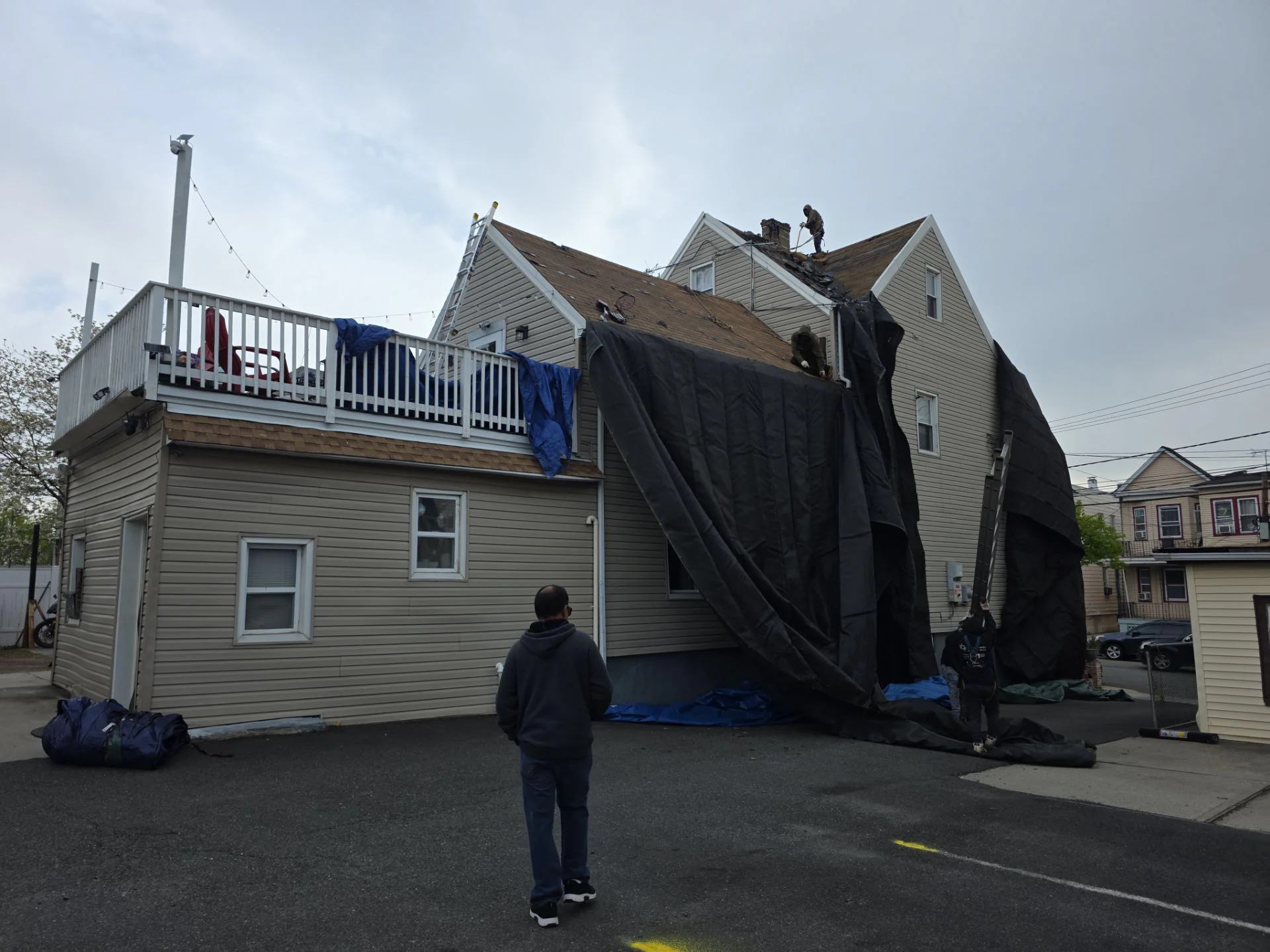
Temporary roof repairs buy you time to schedule permanent fixes, but they’re not substitutes for professional work. A properly installed tarp can protect your home through moderate storms for 30 to 90 days. Roofing cement can seal small cracks temporarily. Plastic sheeting can cover holes until a contractor arrives. These solutions keep water out during emergencies—they don’t fix the underlying problem.
The most effective temporary fix is a heavy-duty tarp, minimum 6-mil poly, at least 4 feet wider and longer than the damaged area. Secure it with 2×4 boards screwed through the tarp into the decking—don’t just weight it with bricks. Extend the tarp over the roof ridge if possible so water can’t run under it from above. This setup holds through moderate weather and prevents additional interior damage while you wait for repairs.
Roofing cement works for very small cracks or temporarily sealing around penetrations, but it’s not a long-term solution. It dries out, cracks in UV exposure, and fails in temperature extremes. Use it to stop an active drip in an emergency, but schedule permanent repairs immediately. The same applies to roofing tape, plastic sheeting, and other quick fixes—they’re stopgaps, not solutions.
When temporary fixes make sense: you’ve discovered a leak late Friday before a holiday weekend and can’t get a contractor until Tuesday. A storm damaged your roof and contractors are backlogged for two weeks. You need to prevent further interior damage while insurance adjusters inspect and approve repairs. In these scenarios, a proper temporary fix prevents a $500 problem from becoming a $5,000 disaster.
When temporary fixes don’t make sense: you’ve already patched the same spot twice. The damage is extensive—multiple leaks, large missing sections, structural concerns. Your roof is old and near replacement anyway. The temporary fix costs approach what permanent repair would cost. In these cases, you’re throwing money at symptoms while the real problem gets worse.
Union County homeowners face specific timing challenges. Storm season brings contractor backlogs. Winter weather limits when repairs can be done safely. Summer humidity affects how quickly materials cure. A temporary fix might need to last longer here than in areas with more predictable weather, which means doing it right—proper tarp installation, secure fastening, adequate coverage—matters more.
The key is understanding what temporary repairs actually accomplish. They keep water out. They prevent additional damage. They give you time to get multiple estimates, check contractor credentials, and make informed decisions. They don’t fix leaks, address underlying causes, or eliminate the need for professional work. Use them as the emergency tools they are, not as long-term solutions.
Getting Gutter and Roof Problems Fixed Right the First Time
Water doesn’t care whether your problem is categorized as a gutter issue or a roof leak. It just goes where it can, causing damage along the way. That’s why treating these systems separately often means fixing the same problem twice—or watching it come back after you thought it was solved. Comprehensive exterior inspection looks at how water moves across your entire home, from where it hits your roof to where it leaves through downspouts.
The most important takeaway: small leaks don’t stay small, clogged gutters don’t just affect gutters, and temporary fixes are exactly that—temporary. Catching problems early, understanding how your roof and gutter systems work together, and getting professional diagnosis when water appears inside your home prevents the exponential damage that turns $300 repairs into $30,000 nightmares. Union County weather doesn’t give homeowners much margin for error. When systems fail here, they fail hard and fast.
If you’re seeing water stains, dealing with overflowing gutters, or trying to figure out where a leak is actually coming from, we bring ten years of Union County-specific experience to the problem. Licensed, insured, and backed by manufacturer certifications, we provide free estimates and transparent pricing for gutter repair, roof leak solutions, and integrated water management that actually works. Your home’s exterior is a system—it should be treated like one.