
Metal Roof Cost 2026: Steel vs Aluminum
Summary:
You’re looking at metal roofing because you’re tired of replacing shingles every 15 years. Smart move. But now you’re stuck trying to figure out whether steel or aluminum makes sense for your Union County, NJ home—and what either one actually costs in 2026. The numbers you’re finding online are all over the place. Some say $7 per square foot, others say $16, and nobody’s explaining what’s included or why the range is so wide. You need real answers that account for New Jersey labor rates, local weather demands, and what you’ll actually pay when the project’s done. This guide gives you transparent pricing, material comparisons, and the context to make a confident decision about your roof investment.
What Determines Metal Roof Cost in 2026
Metal roof pricing isn’t a single number. It’s a combination of material type, roof size, installation complexity, and your location. In Union County, NJ, you’re looking at installed costs between $7 and $16 per square foot for most residential projects in 2026, but that range exists for good reasons.
Your material choice—steel versus aluminum—makes the biggest immediate difference. Steel typically runs $7-12 per square foot installed, while aluminum costs $8-14 per square foot. That’s not a huge gap on paper, but on a 2,000 square foot roof, you’re looking at $14,000-$24,000 for steel versus $16,000-$28,000 for aluminum.
Labor accounts for 40-60% of your total cost. Northern New Jersey labor rates run 10-15% higher than national averages, and Union County sits in a higher-cost labor market. The complexity of your roof matters too. A simple gable roof costs less per square foot than one with multiple valleys, dormers, steep pitch, or architectural details that require precision cutting and custom flashing.
Steel Roofing Cost Breakdown
Steel roofing gives you the most affordable entry point into metal roofing without sacrificing performance. In 2026, galvalume steel (steel coated with aluminum and zinc) costs $7-12 per square foot installed in Union County, depending on whether you choose exposed fastener panels or standing seam systems.
Exposed fastener corrugated panels sit at the lower end—$7-10 per square foot installed. These are the wavy metal panels you see on barns and industrial buildings. They’re durable and budget-friendly, but the exposed screws require periodic maintenance and don’t offer the same weather-tight performance as concealed systems.
Standing seam steel costs $10-12 per square foot installed. The panels interlock with hidden fasteners, creating cleaner lines and better protection against leaks. This is what most residential homeowners choose when they want the longevity of metal with a more finished appearance.
For a typical 2,000 square foot Union County home, you’re looking at $14,000-$20,000 for exposed fastener steel or $20,000-$24,000 for standing seam. Those numbers include materials, labor, underlayment, flashing, and basic trim work. They don’t include old roof removal (add $1-3 per square foot), deck repairs if needed ($2-5 per square foot), or permits ($100-500 in most Union County municipalities).
Steel performs exceptionally well in inland New Jersey. It handles freeze-thaw cycles, heavy snow loads, and the temperature swings common in Union County. The protective coating resists rust and corrosion as long as you’re more than a mile from the ocean. Coastal areas need aluminum.
The gauge (thickness) of your steel affects both cost and performance. Most residential roofs use 26 or 29 gauge steel. Thicker 24 gauge costs more but offers better dent resistance in areas prone to hail or falling branches. Union County’s tree-lined suburbs might justify the upgrade.
Paint systems matter more than most homeowners realize. Standard polyester paint costs less but fades faster. PVDF (Kynar) coatings cost $0.40-1.00 more per square foot but come with 30-40 year fade warranties. If you’re planning to stay in your home long-term, the premium paint system pays for itself in maintained curb appeal and resale value.
Aluminum Roofing Cost Breakdown
Aluminum costs 20-30% more than steel but offers specific advantages that justify the premium in certain situations. In Union County, aluminum roofing runs $8-14 per square foot installed, with most residential projects landing in the $10-12 range for quality standing seam systems.
The price difference comes from the material itself and the installation requirements. Aluminum is lighter than steel—about one-third the weight—which makes it easier to transport and handle, but it’s also softer. That means it dents more easily under impact from hail or falling branches. You’re paying for corrosion resistance, not impact strength.
For a 2,000 square foot roof, aluminum installation typically costs $16,000-$28,000 depending on the panel profile and paint finish. Standing seam aluminum with a premium PVDF coating sits at the higher end of that range. Simpler profiles with standard finishes cost less.
Aluminum makes the most sense if you’re within a mile of the coast or in areas with high humidity and salt air exposure. The material forms a protective oxide layer that prevents rust naturally. Steel requires protective coatings that can fail if scratched or damaged, but aluminum’s corrosion resistance is inherent to the metal itself.
Union County sits inland, so most homeowners don’t need aluminum’s coastal performance. If your home is more than 15 miles from the ocean, painted steel delivers the same longevity at $2-3 less per square foot in materials alone. That’s $4,000-$6,000 in savings on a 2,000 square foot roof.
The weight advantage matters for older homes or structures with limited load capacity. Aluminum puts less stress on your roof framing, which can be important for century-old colonials common in Union County’s established neighborhoods. If your home was built before 1950 and you’re concerned about structural capacity, aluminum’s lighter weight provides peace of mind.
Installation costs for aluminum run similar to steel in terms of labor hours, but you might see slightly lower rates due to faster handling of the lighter panels. The difference isn’t dramatic—maybe 5-10% on labor—but it can offset some of the material premium.
Aluminum also dissipates heat faster than steel because it’s thinner and has better thermal conductivity. On hot summer days, your roof cools down quicker once the sun sets, which can reduce attic temperatures and strain on your HVAC system. The energy savings aren’t as significant as reflective coatings, but they’re measurable over a full cooling season.
Want live answers?
Connect with a USA Home Remodeling LLC expert for fast, friendly support.
Total Project Cost vs Long-Term Value
The upfront number on your estimate isn’t the whole story. Metal roofing costs more initially than asphalt shingles—usually 2-3 times as much—but the total cost of ownership over 30-50 years tells a different story.
A typical asphalt shingle roof in Union County costs $3-5 per square foot installed and lasts 15-25 years given New Jersey’s freeze-thaw cycles and weather stress. That means you’ll replace it 2-3 times over a 50-year period. Factor in inflation, rising labor costs, and disposal fees for each replacement, and you’re looking at $85,000-$100,000 in total roofing costs over five decades.
A metal roof costs $10-16 per square foot installed but lasts 40-70 years with minimal maintenance. You install it once. Total cost over 50 years: $60,000-$75,000 including the initial installation and occasional inspections. The break-even point hits around year 22-27, depending on your specific costs and how long your asphalt shingles actually last.
Roofing Cost Factors Beyond Materials
Your total project cost includes more than just panels and labor. Understanding what else goes into the number helps you evaluate quotes accurately and avoid surprise expenses mid-project.
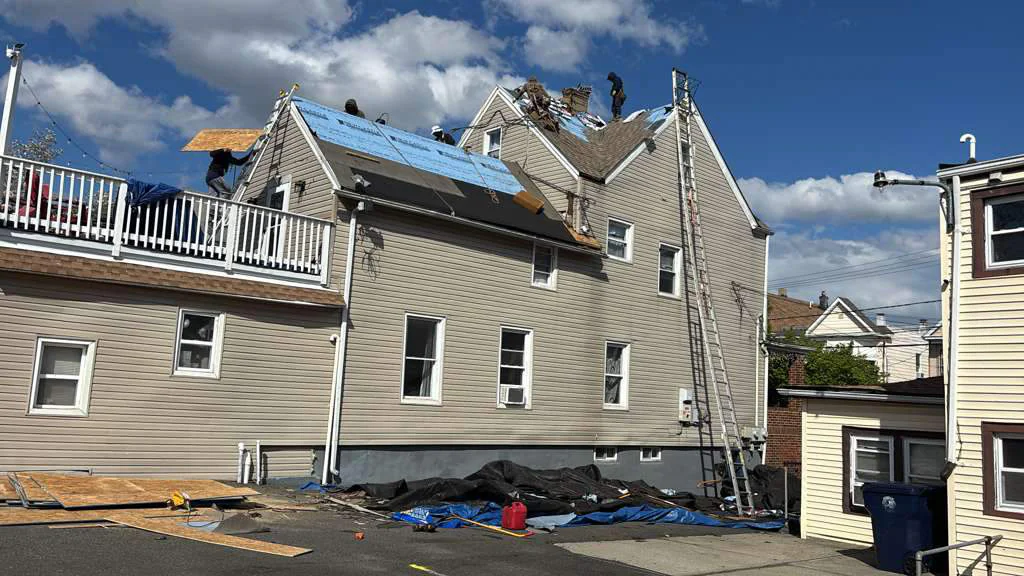
Old roof removal costs $1-3 per square foot in Union County. Most contractors include this as a separate line item. If you have multiple layers of existing shingles, removal costs can double because there’s more material to tear off and haul away. Disposal fees have increased in recent years due to stricter environmental regulations in New Jersey—expect $30-50 per ton for landfill fees.
Underlayment quality affects both cost and performance. Synthetic underlayment costs $0.50-1.50 per square foot but resists wrinkling and moisture better than felt paper. Ice and water shield—a self-adhering membrane required by code at eaves and valleys in New Jersey—adds $1-3 per linear foot. These aren’t optional costs. They’re part of a properly installed system that protects your warranty.
Deck repairs add $2-5 per square foot if your existing roof decking shows rot or water damage. You won’t know this until tear-off, which is why reputable contractors include language in their estimates about addressing hidden damage. If a contractor won’t commit to fixing deck issues that appear during installation, that’s a red flag.
Permits cost $100-500 in most Union County municipalities. Some contractors include permit fees in their quote, others list them separately. Either way is fine as long as the cost is disclosed upfront. Working without permits can void your warranty and create problems when you sell your home.
Flashing and trim work varies by roof complexity. Every penetration—chimneys, skylights, vents, valleys—requires custom flashing to prevent leaks. Simple roofs with few penetrations cost less per square foot than complex roofs with multiple chimneys, dormers, and architectural details. This is where experience matters. Proper flashing installation separates contractors who understand metal roofing from those who treat it like oversized shingles.
Ventilation upgrades often make sense when installing a new roof. Ridge vents, soffit vents, and proper attic airflow extend the life of any roofing system and improve energy efficiency. If your current ventilation is inadequate, budget an additional $300-800 for upgrades. This isn’t a money grab—it’s protecting your investment.
ROI and Energy Savings Over Time
Metal roofing delivers measurable returns beyond just avoiding replacement costs. Energy savings, insurance discounts, and increased home value all contribute to the total ROI calculation.
Reflective metal roofs can reduce cooling costs by 10-25% in Union County’s humid summers. The panels reflect solar radiation instead of absorbing it like dark asphalt shingles. Your actual savings depend on your home’s insulation, HVAC efficiency, and roof color, but most homeowners report $200-400 annual savings on cooling bills. Over a 50-year lifespan, that’s $10,000-$20,000 in cumulative energy cost reduction.
Some insurance companies offer discounts for impact-resistant and fire-resistant roofing. Metal roofs carry a Class A fire rating and resist hail better than asphalt. Discounts vary by provider and your specific policy, but 5-15% reductions on the dwelling coverage portion of your premium are common. Check with your insurance agent before installation to confirm eligibility.
Home value increases vary by market, but metal roofs typically deliver 50-85% ROI at resale. In competitive Union County markets, homes with new metal roofs sell faster and often command premium pricing because buyers recognize they won’t face roof replacement for decades. The exact value increase depends on your neighborhood, home style, and local market conditions, but the perception of quality and low maintenance appeals to buyers.
Maintenance costs for metal roofs run significantly lower than asphalt. You’ll spend money on occasional inspections and clearing debris, but you won’t need the periodic shingle replacements, seal repairs, and moss treatments that asphalt requires. Budget $150-300 annually for basic maintenance versus $500-1,000 for asphalt shingle upkeep.
The warranty protection you get with metal roofing adds value that’s hard to quantify but easy to appreciate. Premium metal roofs come with 30-50 year material warranties, sometimes lifetime coverage. Asphalt shingles max out at 20-30 years, and most warranties are prorated, meaning coverage decreases over time. With metal, you’re covered for the full term at full value in most cases.
Tax credits and rebates for energy-efficient roofing can offset some of your initial cost. Metal roofs with reflective coatings may qualify for federal tax credits or state energy incentives. These programs change regularly, so check current eligibility before installation, but they can reduce your net cost by $500-2,000 depending on the program and your roof size.
Making Your Metal Roof Decision
Steel or aluminum. Exposed fasteners or standing seam. The choice comes down to your specific situation—your location within Union County, your budget, how long you plan to own your home, and what you value most in a roofing system.
If you’re more than a mile from the coast and want the most affordable path to a 50-year roof, steel delivers. If you’re dealing with an older home, high humidity exposure, or want the lightest possible load on your structure, aluminum makes sense despite the premium. Both materials will outlast asphalt shingles by decades and both will save you money over time if you’re planning to stay in your home.
The real key is working with contractors who give you transparent pricing, explain what’s included, and have the manufacturer certifications to back up their warranties. We’ve spent 10+ years installing metal roofing systems in Union County, and we know what actually works in New Jersey weather. We provide free estimates with clear breakdowns of materials, labor, and all project costs—no hidden fees, no surprises when the work starts. If you’re ready to get accurate numbers for your specific roof, reach out and we’ll walk you through your options.